


Weekly Crypto Outlook – May 11, 2026
Crypto markets enter the week with improving momentum as Bitcoin consolidates above $81K, supported by institutional ETF inflows and spot-driven demand rather than leverage. The macro backdrop remains the dominant risk, with the U.S.-Iran conflict keeping oil prices headline-sensitive, inflation sticky, and the Fed constrained. Two key catalysts — the Kevin Warsh Senate confirmation and the CLARITY Act executive session — could shape directional risk for the week ahead.


TL;DR
Crypto enters the week with improving momentum, healthier market structure, and 2 major catalysts ahead.
Bitcoin has found acceptance above $81K after reclaiming the $80K level that had capped the market since late January. This reduces the risk that the move was only a range high deviation.
The rally also looks structurally healthier. Bitcoin is being driven by spot demand rather than leverage, with steady ETF inflows, negative funding, moderate open interest, and continued institutional demand.
The next upside zone is $85K to $86K, with a broader $88K target achievable if Bitcoin holds above the $76K support zone.
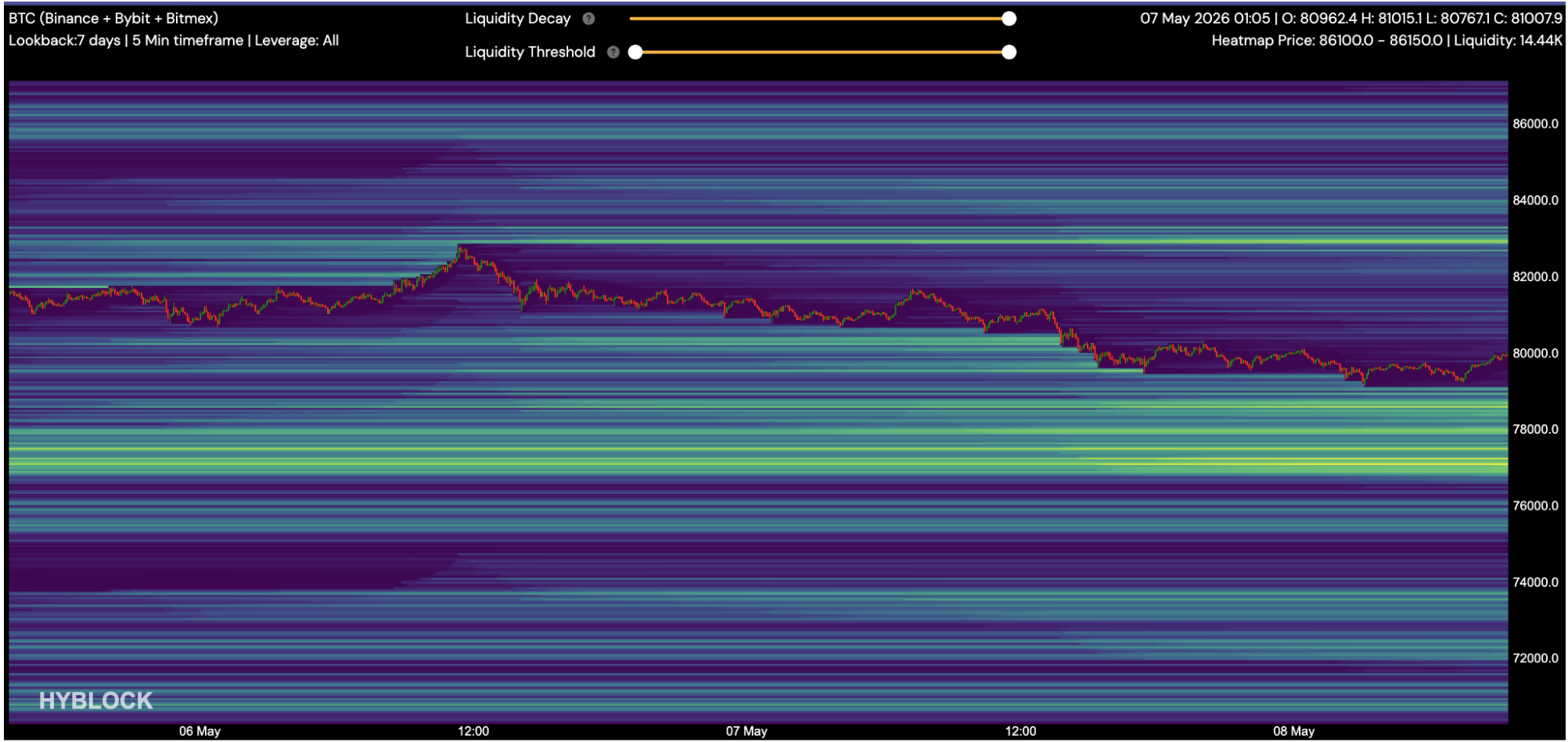
That said, this remains a liquidity and macro driven market. The larger liquidation pool sits to the downside between $78.5K and $77K. Our preferred scenario is for Bitcoin to first rotate lower into that zone, clear long liquidations, then reclaim momentum above $81K and push toward $85K to $86K, clearing the $83K upside liquidity in the process.
Macro remains the key risk. The U.S. and Iran conflict is unresolved, oil remains headline sensitive, inflation is sticky, and the Fed remains constrained. Trump’s May 13 to May 15 summit with Xi in Beijing could become an important geopolitical catalyst if Iran and the Strait of Hormuz dominate discussions.
This week also brings 2 major policy events: Kevin Warsh’s Senate confirmation vote as Fed Chair on May 11, and the Senate Banking Committee executive session on the CLARITY Act on May 14.
The key takeaway: Bitcoin remains the preferred asset. The setup is healthier than last week, but the market still needs macro cooperation. A clean path toward $85K to $86K, and eventually $88K, requires Bitcoin to hold above $76K, inflation data to avoid upside surprises, and policy risk around the Fed, CLARITY Act, and Iran to resolve without disruption.
In This Week’s Note
Macro View
Market Movers and Events, Last Week
Key Macro Drivers, The Week Ahead
Notable Token Unlocks
Market Outlook
Macro View
Bitcoin breaks $80K, but caution is still warranted
Bitcoin’s move back above $80,000 is the most important development of the past 2 weeks, but we would avoid becoming overly optimistic. The rally has been helped by softer oil prices, easing geopolitical risk earlier in the week, and renewed ETF inflows. However, inflation remains sticky, the Fed remains constrained, and uncertainty around the CLARITY Act process has not disappeared despite recent progress.
The break above $80,000 matters because the market had repeatedly failed at this level since late January. It also coincides with important positioning and cost basis markers, including aggregate ETF entry prices and broader institutional positioning. Importantly, this move has been driven more by institutional flows than retail participation. Spot Bitcoin ETFs absorbed roughly $2.9B during April and a further $2B so far in May, while sentiment remains relatively muted and altcoin participation is still selective.
U.S. and Iran conflict remains the key oil risk
The U.S. and Iran conflict remains the main geopolitical risk for markets. President Trump rejected Iran’s latest counterproposal, calling the terms “totally unacceptable.” Iran’s proposal reportedly included an end to the U.S. naval blockade and recognition of Iranian sovereignty over the Strait of Hormuz. The immediate market impact was a renewed oil shock, with markets pricing the risk that the 10 week conflict could drag on and keep the Strait of Hormuz constrained for Western shipping.
This matters for crypto because higher oil prices reinforce sticky inflation, reduce the Fed’s room to cut rates, and increase pressure on risk assets. Despite the technical ceasefire, the military backdrop remains unstable, with reported naval clashes and missile or drone interceptions across the Gulf. Pakistan is acting as mediator, but both sides remain far apart on sanctions, nuclear enrichment, war compensation, and control of the Strait. The recent decline in oil prices helped Bitcoin reclaim $80K, but the geopolitical risk premium has not disappeared. Any further escalation could quickly reverse the disinflation narrative and pressure crypto.
Next key event: Trump and Xi summit in Beijing
President Trump is scheduled to visit Beijing from May 13 to May 15. The itinerary includes arrival on May 13, an official welcome ceremony, bilateral meeting, and state banquet on May 14, followed by a second bilateral meeting over tea and a working lunch on May 15.
Iran is expected to be a central topic. The U.S. is likely to press China to use its influence over Tehran, particularly given China’s role as a major buyer of Iranian oil. For markets, progress on Iran could reduce the oil risk premium and support risk assets. A lack of progress would keep inflation concerns elevated and maintain pressure on crypto.
Stablecoins: final yield text appears finalised
The regulatory backdrop for stablecoins has improved, even as macro conditions remain volatile. On May 1, Senators Thom Tillis and Angela Alsobrooks released the final compromise text on stablecoin yield under Section 404. The text prohibits crypto firms from offering yield that is “economically or functionally equivalent” to bank deposit interest, while preserving activity based rewards such as transaction incentives and loyalty programmes. Coinbase and Circle backed the deal, and Polymarket odds on passage jumped from 46% to 65%. Banking sector pushback followed on May 4, with 5 trade groups arguing that the language remains too broad and could pressure traditional bank lending.
The banking sector’s pushback highlights the disruptive potential of stablecoins. The senators have publicly closed the door on reopening the yield text, and the procedural path to a May markup remains intact. The realistic timeline points to a Banking Committee markup during the week of May 11 to May 15, a Senate floor vote in June, bicameral reconciliation through June and July, and a potential presidential signature before the August recess. The main risk is delay rather than a reopening of the compromise. Key failure modes include a markup slipping past mid May, difficulty reaching 60 votes in the Senate, disagreement during reconciliation, or DeFi protections being routed through an additional committee step. Bitcoin itself is less dependent on this process given its spot ETFs, institutional access, and clearer commodity treatment. The bigger beneficiaries of regulatory clarity would be Ethereum, stablecoins, DeFi, and selected altcoins.
Still a liquidity driven environment
The macro backdrop remains the key risk. The Fed remains constrained by resilient labour markets and persistent inflation pressures. Markets are now pricing in no interest rate cuts over the next year, while the Fed leadership transition adds another layer of uncertainty.
Several risks could interrupt the rally: renewed escalation around Iran and the Strait of Hormuz, hotter inflation data, or delays to the CLARITY Act timetable. The medium term backdrop for Bitcoin remains constructive, supported by tightening supply, institutional adoption, and concerns around fiscal sustainability and monetary debasement. However, this remains a flow and liquidity driven environment rather than the start of a clean, policy supported expansion cycle.
Market Movers and Events, Last Week
Market data and flows
Crypto market cap: $2.69T, +2.7% WoW
Average weekly volume: $123B, 2% above average
Bitcoin weekly volume: $35.3B, 14% above average
Ethereum weekly volume: $18.9B, 40% above average
Ethereum network fees: 0.28 Gwei
Market activity improved meaningfully, with both Bitcoin and Ethereum volumes above average.
The key distinction is that Bitcoin’s rally appears to be driven by spot demand rather than leverage. With improving volumes and moderate inflows, the $88K Bitcoin target remains achievable if Bitcoin holds above the $76K support zone.
Futures and positioning
Bitcoin funding rate: minus 4.8%, down 0.5% WoW
Bitcoin open interest: $25.6B, +$100M WoW
Ethereum funding rate: +8.4%, up 8.3% WoW
Ethereum open interest: $12.5B, down $100M WoW
Bitcoin positioning remains structurally healthy. Negative funding, moderate open interest, and continued ETF inflows suggest this is not yet a crowded speculative move.
Ethereum positioning is less clean. Funding has risen while open interest declined slightly, supporting the view that ETH remains a weaker beta to Bitcoin.
ETF flows
Bitcoin ETF flows, 7 days: +$630M
Bitcoin ETF flows, 30 days: +$3.2B
Bitcoin ETF inflows in May: +$1.3B
Bitcoin ETF inflows over the last 3 months: +$4.6B
Ethereum ETF flows, 7 days: +$71M
Ethereum ETF flows, 30 days: +$568M
Bitcoin ETF inflows indicate genuine long only buying while funding remains negative. This is the most important positive flow signal of the week.
Ethereum ETF flows have improved, but remain smaller and less consistent, supporting a more cautious view on ETH relative to BTC.
Stablecoins and liquidity
USDT market cap: $189.6B, +0.05% WoW
USDT volume: $127.1B, 16% above average
USDC market cap: $77.8B, +0.8% WoW
USDC volume: $41.4B, 21% below average
Weekly stablecoin net change: +$0.7B
30 day minted: +$2.4B
The increase in USDT volume is constructive for altcoins, but net issuance remains moderate. Liquidity is improving, but not yet strong enough to confirm a broad altcoin expansion cycle.
Dominance
Bitcoin dominance: 60%, down 0.4% WoW
Ethereum dominance: 10.4%, down 0.3% WoW
Altcoin participation is broadening, but not yet enough to justify an allocation shift away from Bitcoin.
Bitcoin is still expected to outperform in the near term, but the market is moving closer to the point where broader altcoin participation could support a rotation. CLARITY Act progress would be the key confirmation signal, as regulatory clarity would likely benefit Ethereum, DeFi, and higher beta altcoins more directly than Bitcoin.
The correct interpretation is:
Bitcoin remains the preferred asset
Altcoin participation is improving
A broader rotation into altcoins is becoming more plausible
Confirmation requires stronger ETH performance, sustained stablecoin liquidity, and progress on the CLARITY Act
SUI was the most notable mover last week, showing that selective altcoin risk appetite is returning
Key Headlines
Morgan Stanley enters spot crypto trading on E*Trade
Morgan Stanley has begun a pilot rollout of spot Bitcoin, Ether, and Solana trading on ETrade. The service is live in pilot form and is expected to become available to all 8.6M ETrade clients later this year. The bank is charging 50 bps per transaction, below Coinbase, Robinhood, and Charles Schwab. The move expands Morgan Stanley’s crypto strategy beyond its spot Bitcoin ETF, MSBT, and creates a pathway into custody, crypto to ETF conversions, and tokenised equity trading. The implication is structural: traditional financial platforms are moving closer to spot execution, custody, and tokenised securities infrastructure. This is supportive for long term adoption, particularly for Bitcoin, Ethereum, and Solana.
Bermuda accelerates its onchain economy plan
Bermuda is continuing to push its digital asset strategy forward. Premier David Burt confirmed at Consensus Miami 2026 that Bermuda will conduct a second USDC airdrop linked to next week’s Bermuda Digital Finance Forum. The initiative builds on the 2025 forum, where 100 USDC was distributed to each attendee for use with newly onboarded local merchants.
The program is being executed with Circle and Coinbase and is designed to expand real world digital payments adoption across Bermuda’s merchant network. The key takeaway is that Bermuda is positioning itself as a practical test case for an onchain economy, connecting regulation, stablecoin infrastructure, merchants, and consumer usage into a working payments ecosystem.
Strategy walks back its never sell doctrine
Strategy has softened one of its most important Bitcoin narratives.
On the company’s Q1 2026 earnings call, Michael Saylor said the firm would “probably sell some Bitcoin to fund a dividend just to inoculate the market.” CEO Phong Le also said the company could consider selling Bitcoin to buy U.S. dollars or retire debt, provided the action is accretive to Bitcoin per share.
This is a significant shift from the company’s previous never sell posture. Strategy reported a $12.54B net loss for Q1, driven by a $14.46B unrealised loss on its Bitcoin holdings. The company still holds 818,334 BTC, roughly 3.9% of total supply. The implication is important: Strategy remains a major structural source of Bitcoin demand, but the market can no longer treat its holdings as completely immovable supply. This does not mean forced selling is imminent. However, it introduces a new risk factor around corporate treasury management, dividend funding, leverage, and debt optimisation.
SUI leads altcoin strength
SUI was the most notable mover last week, rallying sharply as institutional staking activity tightened available liquid supply. SUI Group Holdings reportedly moved 108.7M SUI into long term staking, representing roughly 2.7% of circulating supply.
The move was further amplified by rising trading volumes, short liquidations, and improving sentiment around the Sui ecosystem. While the rally shows selective altcoin risk appetite is returning, the sharp move also leaves SUI vulnerable to short term profit taking.
Key Macro Drivers, The Week Ahead
Monday, May 11: Kevin Warsh Senate vote
The Senate is expected to vote on Kevin Warsh’s confirmation as Fed Chair, replacing Jerome Powell, whose term expires May 15. Warsh is widely regarded as more hawkish on inflation but less interventionist than Powell. The transition appears largely priced in, but a smooth confirmation would remove a key uncertainty overhang.
Tuesday, May 12: Consumer Price Index
CPI is the most important inflation release of the week. A softer print would support Bitcoin’s breakout by easing inflation pressure. A hotter print would challenge the rally by reinforcing higher for longer rate expectations, especially if oil remains elevated.
Wednesday, May 13: Producer Price Index
PPI will show whether inflation pressure is building upstream, particularly through energy and shipping costs.
Thursday, May 14: Retail Sales
Retail sales will show whether the U.S. consumer remains resilient despite higher prices and tighter financial conditions. A strong print could be interpreted as inflationary if CPI and PPI are hot. A weak print may support rate cut expectations, but could also raise growth concerns.
Thursday, May 14: CLARITY Act executive session
The Senate Banking Committee is expected to review the CLARITY Act on May 14, making this the key crypto specific event of the week. This matters more for Ethereum, stablecoins, DeFi, exchanges, and altcoins than for Bitcoin itself. Bitcoin already has spot ETFs and clearer commodity treatment.
Friday, May 15: Industrial Production
Industrial production gives a read on manufacturing, mining, and real economy activity.
Notable Token Unlocks, May 11 to May 17
Monday, May 11
Based, BASED
Approximate value: $5.28M
Supply impact: 20.41% of circulating supply
Solayer, LAYER
Approximate value: $3.43M
Supply impact: 7.26% of supply
io.net, IO
Approximate value: $2.13M
Supply impact: 3.95% of supply
Tuesday, May 12
Avalanche, AVAX
Approximate value: $17.25M
Supply impact: 0.31% of supply
Aptos, APT
Approximate value: $13.2M
Supply impact: 0.67% of circulating supply
Recipient groups: Community, Foundation, and Core Contributors
Pump.fun, PUMP
Approximate value: $17.6M
Supply impact: 2.77% of circulating supply
Recipient groups: Community and Ecosystem
Thursday, May 15
Starknet, STRK
Approximate value: $6.73M
Supply impact: 4.05% of supply
Sei, SEI
Approximate value: $4.22M
Supply impact: 0.95% of supply
Saturday, May 16
Arbitrum, ARB
Approximate value: $13.4M
Supply impact: 1.71% of circulating supply
Recipient groups: Team, Advisors, and Investors
Sunday, May 17
zkSync, ZK
Approximate value: $3.36M
Supply impact: 2.80% of supply
Solv Protocol, SOLV
Approximate value: $2.81M
Supply impact: 17.29% of supply
Market Outlook
Sentiment
Bitcoin Greed and Fear: 84% vs 85% last week
Ethereum Greed and Fear: 65% vs 70% last week
Sentiment has improved since the February bottom, but the latest readings are not yet euphoric. This supports the view that the current move is being driven more by spot demand and institutional flows than retail speculation.
Bitcoin
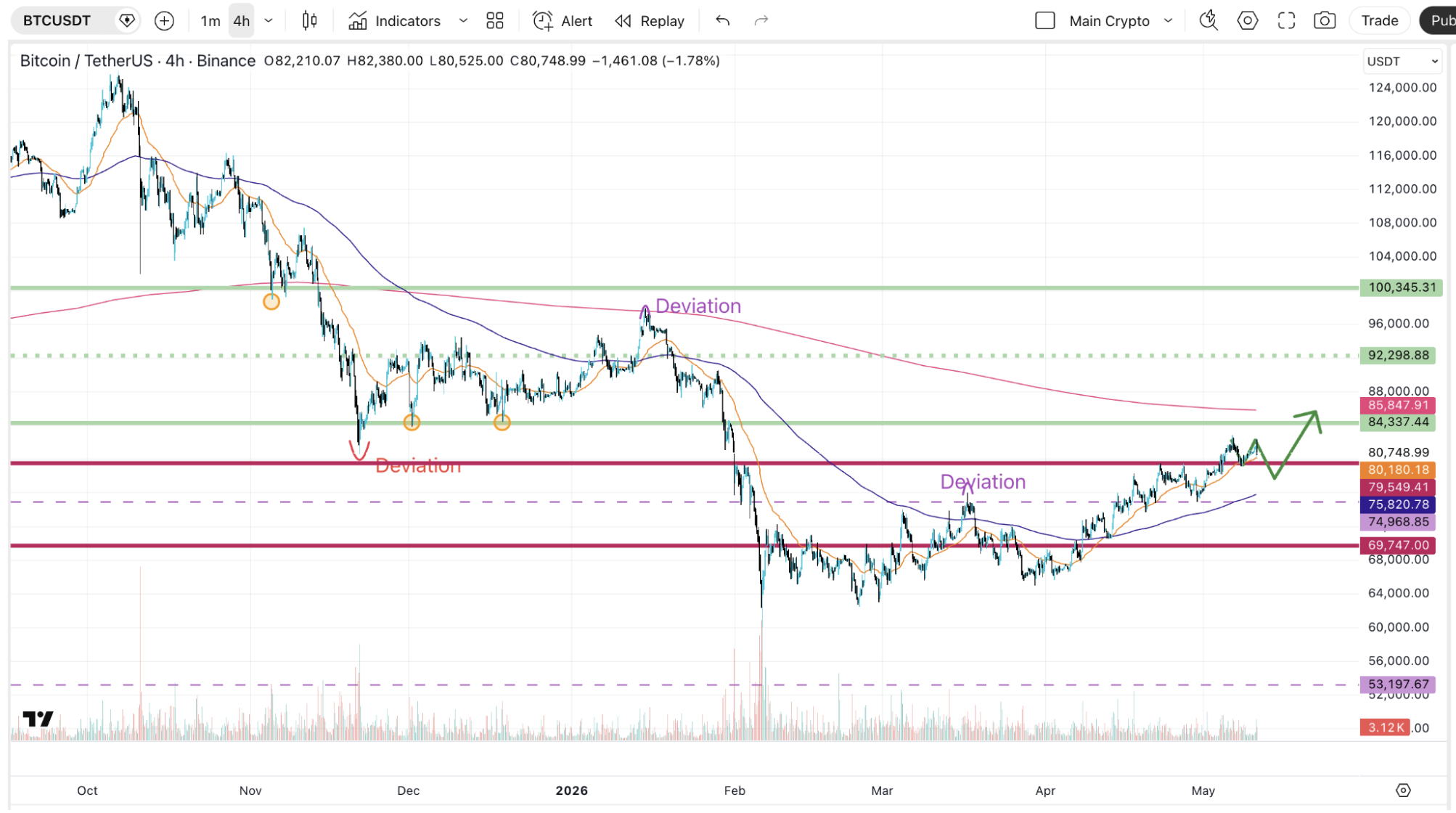
Support zone: $76,000
Short term upside: $85,000 to $86,000
Larger upside target: $88,000
Upside liquidation zone: $83,000
Downside liquidation zone: $78,500 to $77,000
Bitcoin has found acceptance above $81K and the EMAs have caught up, giving the market a cleaner bullish structure than last week. The key risk last week was that the move above $80K could be a range high deviation. Now that price has settled above $81K, the probability of continuation has improved. If Bitcoin holds this acceptance zone, the next likely target is $85K to $86K, with $88K still achievable.
There are liquidations on both sides, but the larger pool remains to the downside between $78.5K and $77K. Our preferred scenario is for Bitcoin to first rotate lower into that zone, clear long liquidations, and then reclaim momentum above $81K. If the reaction is strong, the next target becomes $83K first, followed by $85K to $86K.
The tactical path is therefore:
First, monitor whether price rotates lower into the $78.5K to $77K liquidity zone
Then, assess whether buyers step back in and reclaim momentum above $81K
If momentum resumes, watch for Bitcoin to clear $83K and extend toward $85K to $86K
The BTC trend model remains bullish. If Bitcoin remains above the $76K zone, the focus should remain on the $85K to $86K target. The bullish structure remains valid while Bitcoin holds above the $76K area. A loss of $76,000 would weaken the broader setup materially.
Ethereum
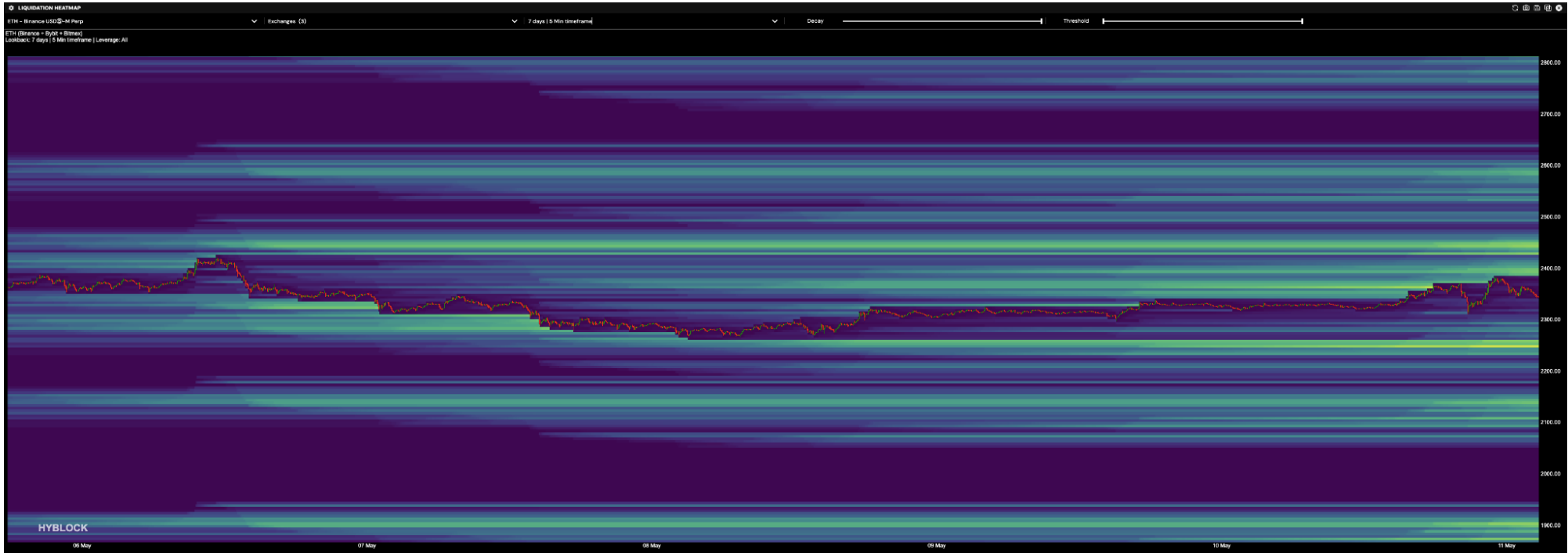
Support zone: $2,250
Short term upside: $2,500 to $2,550
Larger upside target: $2,700
Upside liquidation zone: $2,450
Downside liquidation zone: $2,250 to $2,100
Ethereum remains lackluster and continues to trade as a weaker beta to Bitcoin.
ETH ETF flows have improved, but they remain small compared with Bitcoin. Funding has also increased, which makes the ETH setup less clean than BTC from a positioning perspective. Ethereum needs either a clean move through the $2,450 upside liquidation zone, a positive CLARITY Act catalyst, a broader altcoin rotation signal, or stronger ETF inflows. If Ethereum can reclaim momentum above $2,450, the next upside target is $2,500 to $2,550, followed by the larger $2,700 zone. On the downside, failure to hold $2,250 would open the risk of a move toward the broader $2,250 to $2,100 downside liquidation zone.
Altcoins
Altcoin participation is improving, but still selective.
The rally is broadening as Bitcoin grinds higher, but the market has not yet confirmed a full altcoin rotation. Bitcoin is still expected to outperform in the near term, but the market is moving closer to the point where broader altcoin participation could support a rotation. CLARITY Act progress would be the key confirmation signal, as regulatory clarity would likely benefit Ethereum, DeFi, and higher beta altcoins more directly than Bitcoin. Until then, altcoin exposure should remain selective. SUI was the clearest example of returning altcoin appetite last week, but broader confirmation still requires stronger Ethereum performance, sustained stablecoin liquidity, and continued improvement in market breadth.
Disclaimer: This content presents objective market data and does not constitute investment advice.

Copyright © 2026 Rain Trading Limited