



TL;DR
Crypto continues to recover from oversold levels, but the move remains tactical rather than structural.
Total crypto market cap stands at $2.21T, up 3.8% from last week. Volumes remain weak, with average weekly volume around $76B, 35% below average. Bitcoin volume was $30.1B, 36% below average, while Ethereum volume was $12.8B, 45% below average.
The market is no longer under the same liquidation pressure as early June, but liquidity remains poor. Stablecoin activity is still weak, ETF demand has not clearly recovered, and institutional attention remains divided between crypto and AI.
The main event this week is the Fed meeting on Wednesday, June 17. The market is not expecting a major policy change, but Kevin Warsh’s first meeting as Fed Chair will matter for tone, forward guidance, inflation interpretation, and the updated rate projections.
The U.S. and Iran have reached a framework peace agreement, with a formal signing expected on Friday in Switzerland. This is a meaningful de-escalation and should reduce the immediate oil shock risk. However, the deal still needs to be implemented, the Strait of Hormuz will reopen gradually, and longer term issues including Iran’s nuclear program remain unresolved.
Bitcoin has room to continue the relief rally toward $68.5K to $69K. That zone is the area to watch for signs of exhaustion. A renewed push above that area would open the door to the larger $79K to $80K liquidity zone, but the more likely scenario is exhaustion near $69K followed by a retest of the recent lows.
Ethereum has also bounced, but remains weaker than Bitcoin. ETH needs to reclaim $1,850 before the short term structure improves meaningfully.
In This Week’s Note
Macro View
Market Movers and Events, Last Week
Key Headlines
Key Macro Drivers, The Week Ahead
Notable Token Unlocks
Market Outlook
Macro View
Macro remains the main driver for crypto.
Last week’s inflation data was mixed. Core CPI came in below expectations, which helped ease some near term pressure. The complication remains energy. Gasoline was a major contributor to the latest headline CPI print, keeping headline inflation well above the Fed’s 2% target.
The important change this week is geopolitical. The United States and Iran have reached a framework peace agreement to end the 108 day conflict, with a formal signing ceremony expected this Friday in Switzerland. Military operations are expected to stop immediately, the U.S. naval blockade on Iranian ports is set to be lifted, and the Strait of Hormuz should gradually reopen over the next 30 days as Iranian forces clear naval mines.
This reduces the immediate stagflation tail risk. A sustained reopening of Hormuz would reduce pressure on oil prices and make it harder for markets to price a fresh inflation shock from energy. That is supportive for risk assets, including Bitcoin, at least in the short term.
However, the deal is not yet a full resolution. The agreement starts a 60 day negotiation window covering longer term issues, including Iran’s nuclear program and outstanding UN and IAEA resolutions. Iran is also seeking the release of frozen assets, with an initial $12B package reportedly under discussion. Implementation risk remains, and the market will need to see whether the ceasefire holds and whether Hormuz reopens smoothly.
The key question is whether markets are overpricing the risk of further rate hikes. The incoming Fed Chair, Kevin Warsh, takes over in a difficult environment. Inflation is still too high, but the de escalation in the Gulf gives the Fed more room to avoid overreacting to energy driven inflation.
Warsh’s recent comments suggest a more nuanced approach. He has pointed to the deflationary impact of AI and has been cautious about overreacting to supply side energy shocks. That could allow him to sound less hawkish than the market expects. However, he is also known for preferring less forward guidance, so the market may not get full clarity from this meeting.
For Bitcoin, the setup is clearer than last week. The Iran framework reduces the immediate oil shock risk and supports the relief rally. A softer Fed tone and stable inflation expectations would help the move continue. A hawkish Fed, or a rate projection path that validates the market’s hike pricing, would likely cap the recovery and bring the recent lows back into focus.
Market Movers and Events, Last Week
Market data and flows
Crypto market cap: $2.21T, up 3.8% WoW
Average weekly volume: $76B, 35% below average
Bitcoin weekly volume: $30.1B, 36% below average
Ethereum weekly volume: $12.8B, 45% below average
Ethereum network fees: 0.11 Gwei
The market has bounced from oversold levels, but the recovery is happening on weak volume. That makes the move less convincing.
The lack of volume suggests that the rebound is mostly a positioning reset rather than the start of a broad accumulation phase. A stronger trend needs higher spot demand, better ETF flows, and renewed stablecoin growth.
Futures and positioning
Bitcoin funding rate: 3%
Bitcoin open interest: $21.4B
Ethereum funding rate: 8%
Ethereum open interest: $10.3B
Leverage is no longer the main source of pressure. Open interest has stabilized after the recent reset, and funding is not showing signs of aggressive short positioning.
This supports the case for a tactical bounce. However, it does not yet confirm a durable trend reversal. The market still needs stronger spot buying to sustain upside.
Dominance and rotation
Bitcoin dominance: 58.8%
Ethereum dominance: 9.2%
Bitcoin dominance remains below 60%, but this does not yet confirm a broad altcoin rotation. Ethereum dominance remains weak, and there is still no clear leadership from ETH.
The setup continues to favor Bitcoin over altcoins. Stablecoin liquidity is weak, ETF demand is uneven, and most altcoins remain dependent on idiosyncratic catalysts rather than broad market beta.
Stablecoins and liquidity
USDT market cap: $186.5B, down 0.21% WoW
USDT volume: $64.9B, 33% below average
USDC market cap: $74.7B, down 1.2% WoW
USDC volume: $10.8B, 32% below average
Weekly stablecoin net change: minus $1.3B
30 day stablecoin off ramp: $5.2B
Stablecoins remain the weakest part of the setup.
The market can bounce without fresh stablecoin inflows, but it is difficult to build a sustainable trend while liquidity is leaving the system. A real improvement in stablecoin minting would be one of the most important signals to watch.
ETF and institutional flows
Institutional demand remains soft. A large part of the recent outflows appears linked to the unwinding of basis trades, with iShares notably affected.
The broader issue is attention. AI continues to absorb liquidity and mindshare. In client conversations, the message remains consistent: crypto is not being abandoned, but it is being pushed down the priority list in favor of AI exposure.
This matters for Bitcoin. BTC has repeatedly failed to break above the $80K area, which aligns closely with the 200 day moving average. A sustained break higher probably requires a more dovish Fed tone, lower inflation expectations, and a stabilization in ETF flows.
Sentiment
Bitcoin Greed and Fear: 17%, up from 2% last week
Ethereum Greed and Fear: 16%, up from 1% last week
Sentiment has improved from panic levels, but remains low. This supports a tactical bounce, not yet a confirmed trend reversal.
Key Headlines
Citigroup moves private company shares on chain
Citigroup has launched a blockchain based platform that allows wealthy and institutional clients to trade tokenized interests in private companies.
The first transaction gave clients exposure to Kaleido through tokenized depositary receipts on infrastructure operated by Switzerland based SIX. Citi is also discussing participation with major private companies.
The timing is important. Investor demand for late stage private companies is rising, especially around anticipated listings such as SpaceX and Anthropic. This is another sign that tokenisation is moving from pilot phase to institutional product development.
On chain infrastructure is attracting traditional finance capital
Digital Asset, the company behind Canton Network, raised $355M in a round led by a16z crypto. Investors included HSBC, Apollo, BNP Paribas, Citadel Securities, CME Ventures, Coinbase Ventures and other major financial institutions.
This is structurally positive for the space. The more traditional finance invests directly in regulated on chain infrastructure, the more likely tokenisation becomes a durable medium term theme.
Figure acquires Kiavi in another crypto M&A transaction
Figure Technology Solutions announced a definitive agreement to acquire Kiavi for $717M.
The deal brings a large real estate lending platform onto Figure’s blockchain native capital marketplace. It is another example of crypto infrastructure moving into traditional asset classes rather than remaining limited to crypto native products.
FCA considers broader crypto ETN access
The UK Financial Conduct Authority proposed allowing authorised investment funds, including UCITS schemes and most non UCITS retail schemes, to hold up to 10% of their assets in crypto ETNs.
This is not an immediate price catalyst, but it is directionally positive. It would give regulated fund structures a clearer path to crypto exposure and follows the FCA’s earlier decision to reopen retail access to crypto ETNs.
Hyperliquid and pre IPO price discovery
Hyperliquid continues to be one of the more interesting crypto native use cases.
The SpaceX pre IPO perpetual market has shown strong demand and meaningful volume. These products are speculative and carry clear risks, but they also demonstrate a genuine use case for blockchain infrastructure: 24/7 price discovery for assets that are not yet easily accessible in traditional markets.
This is one of the few areas where crypto is creating a new market structure rather than simply replicating existing financial products.
Key Macro Drivers, The Week Ahead
Wednesday, June 17: U.S. Retail Sales
Retail Sales and the Retail Sales Control Group are the key growth data points this week.
The market will look for signs that higher inflation, higher energy prices, and tighter financial conditions are starting to affect consumption. A strong number would support the view that the economy remains resilient, but it could also make the Fed less comfortable easing policy.
Wednesday, June 17: Fed Interest Rate Decision
The Fed decision is the main event of the week.
The market is focused less on the rate decision itself and more on the tone. Investors will watch whether the Fed validates the recent repricing toward possible hikes, or whether Warsh pushes back against the idea that energy driven inflation requires a more aggressive policy response.
Wednesday, June 17: FOMC Economic Projections and Rate Projections
The updated projections matter because they will show whether the Fed sees inflation as temporary or persistent.
For crypto, the rate projections are the key part. A higher path would be negative for Bitcoin and high beta assets. A more balanced projection path would support the recovery.
Wednesday, June 17: FOMC Press Conference
This will be Kevin Warsh’s first Fed press conference.
The market will pay close attention to how he discusses inflation, oil, AI, forward guidance, and the balance sheet. A measured tone could help risk assets. A hawkish tone would likely cap Bitcoin’s recovery near resistance.
Friday, June 19: U.S. and Iran peace deal signing
The formal signing of the U.S. and Iran framework agreement is expected on Friday in Switzerland.
This is an important geopolitical event for markets. A smooth signing would reinforce the de escalation narrative, reduce oil shock risk, and support risk appetite. Any delay, disagreement over terms, or pushback from hardliners would reintroduce uncertainty.
Notable Token Unlocks, June 16 to June 20
LayerZero, ZRO
Unlock date: Saturday, June 20
Approximate value: $23.2M
Amount: 25.71M ZRO
Supply impact: 4.83% of circulating supply
This is the largest dollar value unlock of the week and should be monitored closely.
Spark, SPK
Unlock date: Wednesday, June 17
Approximate value: $17.8M
Amount: 900M SPK
Supply impact: 27.08% of circulating supply
This is the most important unlock from a supply dilution perspective. The percentage of circulating supply is high, making SPK vulnerable around the event.
Connex, CONX
Approximate value: $14.5M
Supply impact: 47.3% of circulating supply
This is a very large supply impact, even if liquidity is lower than the larger names. It should remain on watch.
Arbitrum, ARB
Unlock date: Tuesday, June 16
Approximate value: $7.8M
Amount: 9.26M ARB
Supply impact: 1.68% of circulating supply
The dollar value is moderate, and the supply impact is manageable relative to other unlocks this week.
KAITO, KAITO
Unlock date: Saturday, June 20
Approximate value: $7.4M
Amount: 17.6M KAITO
Supply impact: 4.49% of circulating supply
The supply impact is meaningful and could matter if liquidity remains weak.
YZY, YZY
Unlock date: Wednesday, June 17
Approximate value: $6.2M
Amount: 20.83M YZY
Supply impact: 4.27% of circulating supply
The unlock is smaller in dollar terms but still relevant due to the supply percentage.
Market Outlook
Bitcoin
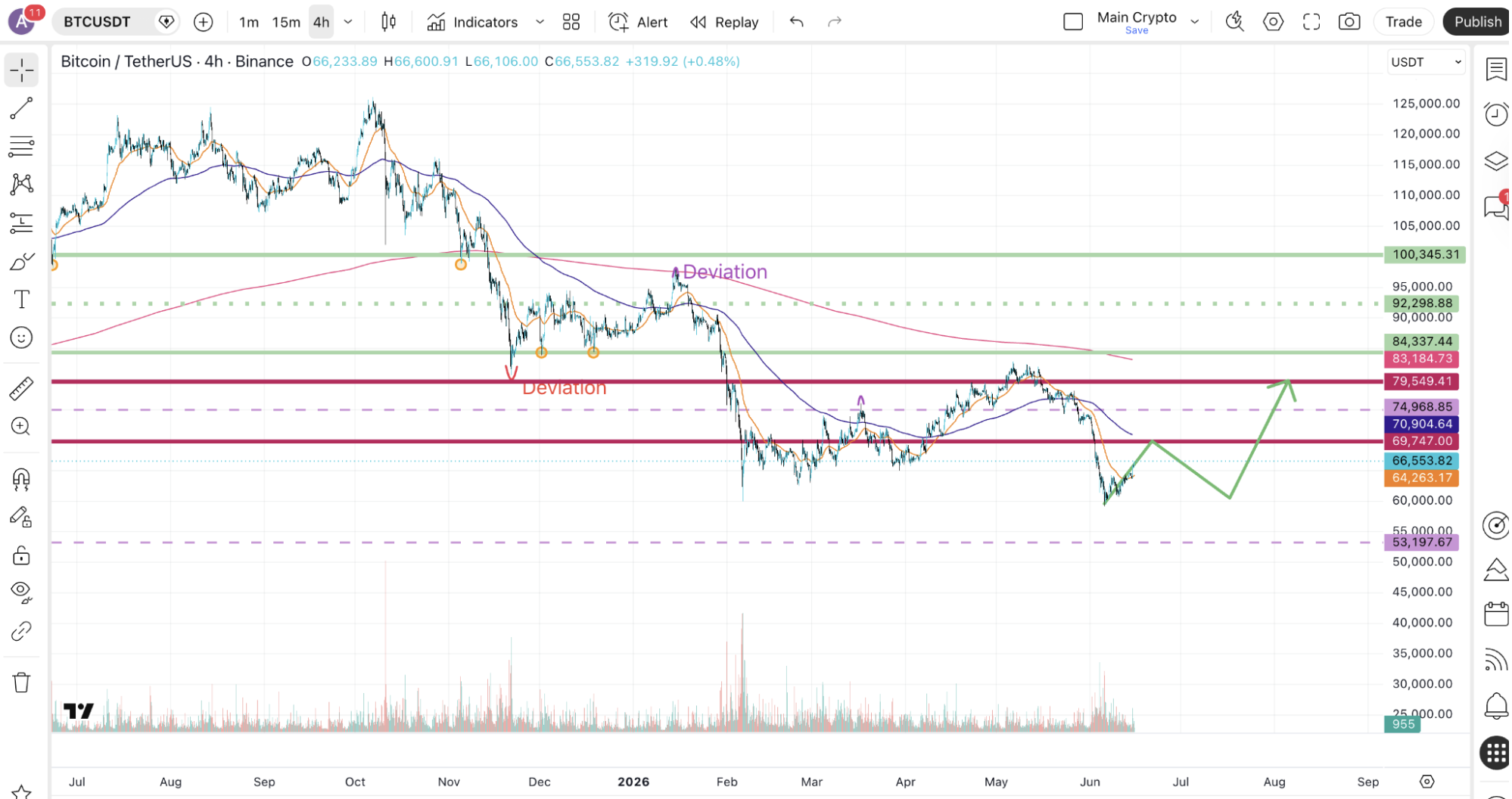
Support zone: recent lows and low $60Ks
Key short term level: $68.5K to $69K
Recovery zone: $68.5K to $69K
Major upside liquidity zone: $79K to $80K
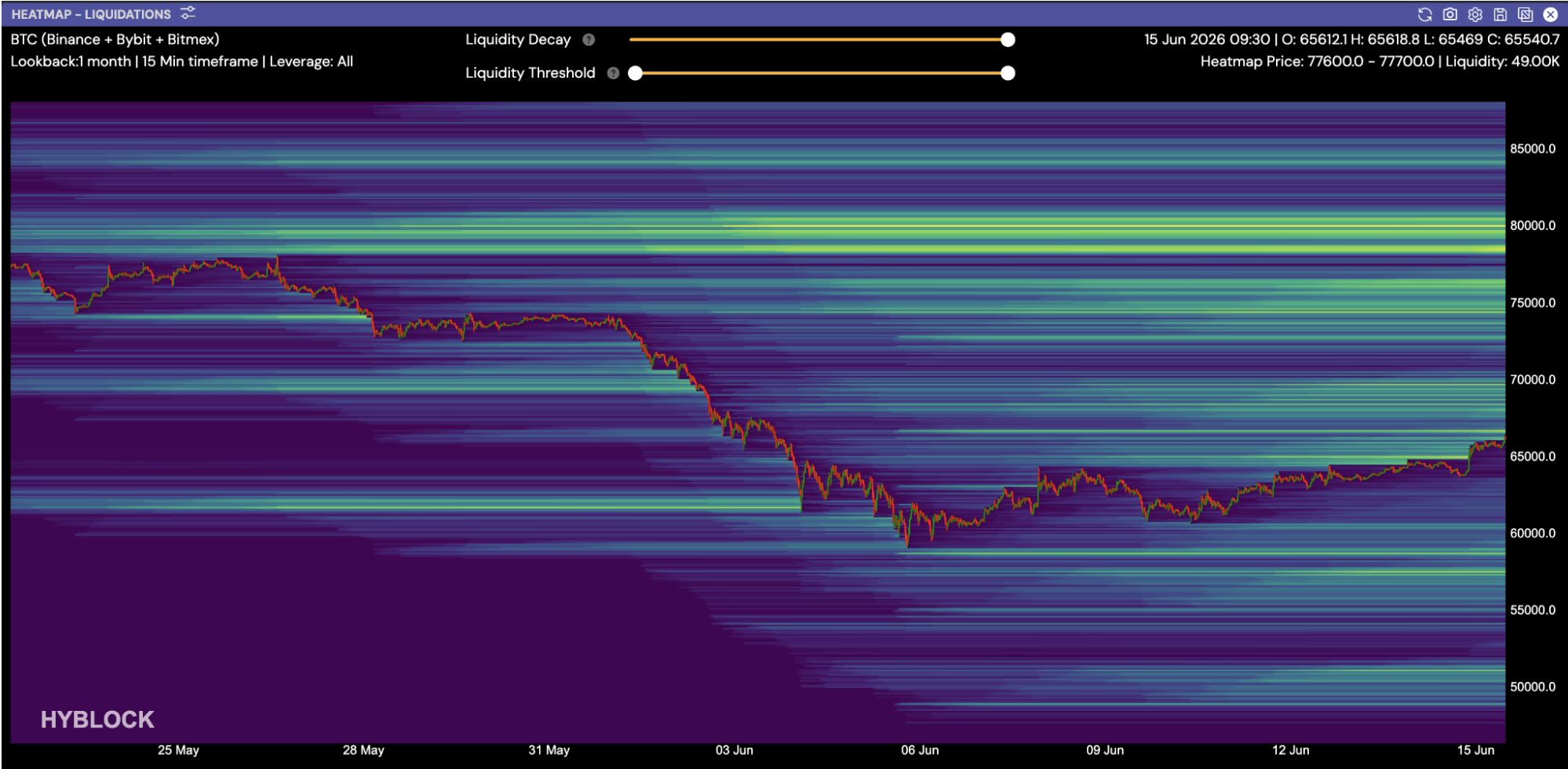
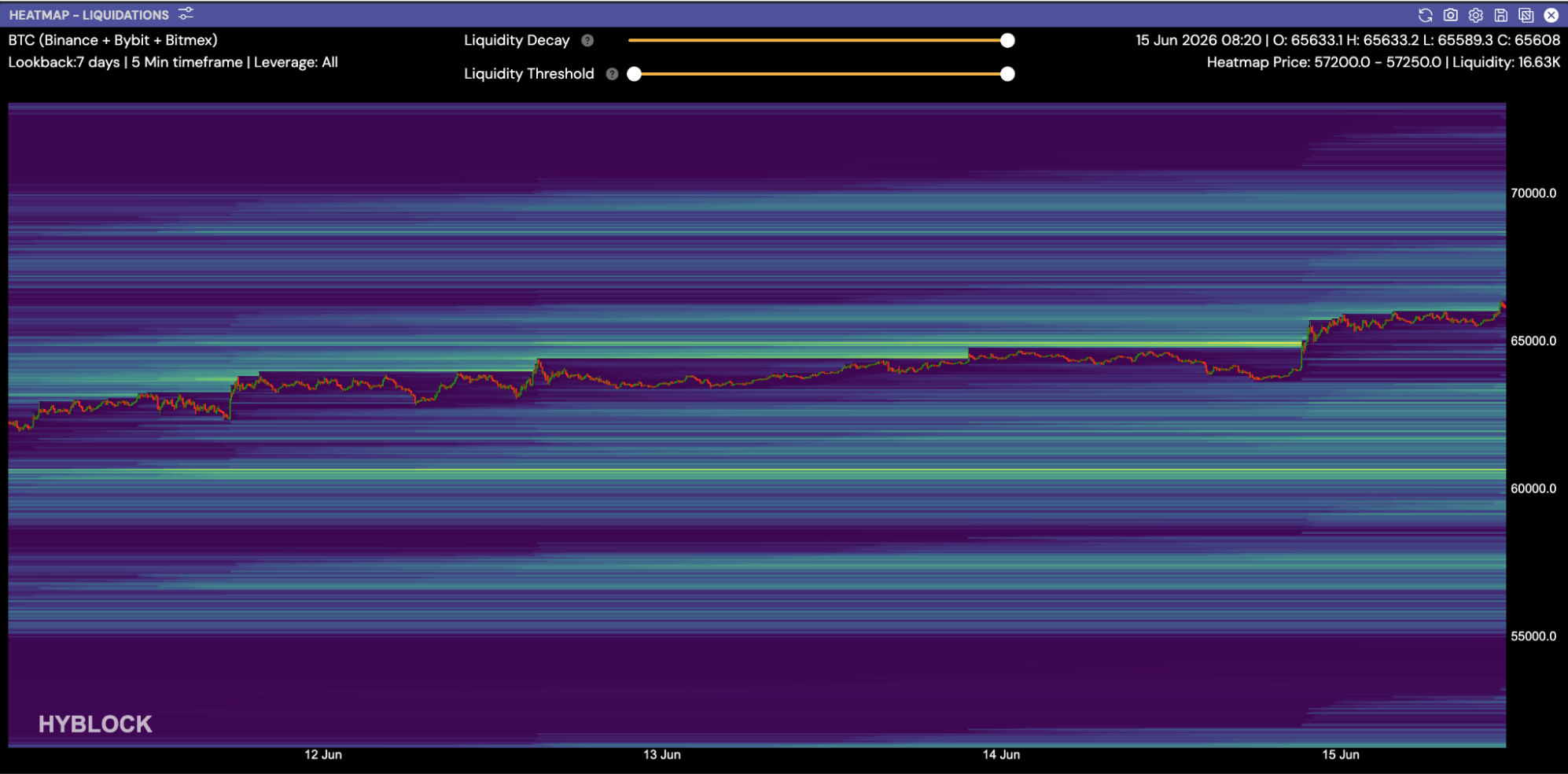
Bitcoin is recovering, but the move remains tactical.
The market has rebounded from oversold conditions, and the current positioning setup allows for a continuation toward $68.5K to $69K. This is the key area to watch this week.
The U.S. and Iran framework agreement improves the short term macro backdrop by reducing oil shock risk. That should help the relief rally, especially if crude continues to move lower and inflation expectations stabilize.
However, the long and short positioning picture is more supportive of exhaustion near the $68.5K to $69K zone than a clean breakout. If Bitcoin reaches that area and momentum fades, the more likely scenario is a retest of the recent lows.
A clean push through $69K would improve the short term picture and open the door to a larger move toward the $79K to $80K liquidation zone. However, that is not the base case for now.
The market still lacks the ingredients for a sustained breakout: ETF flows are not strong enough, stablecoin liquidity remains weak, and the Fed meeting creates macro risk.
Ethereum
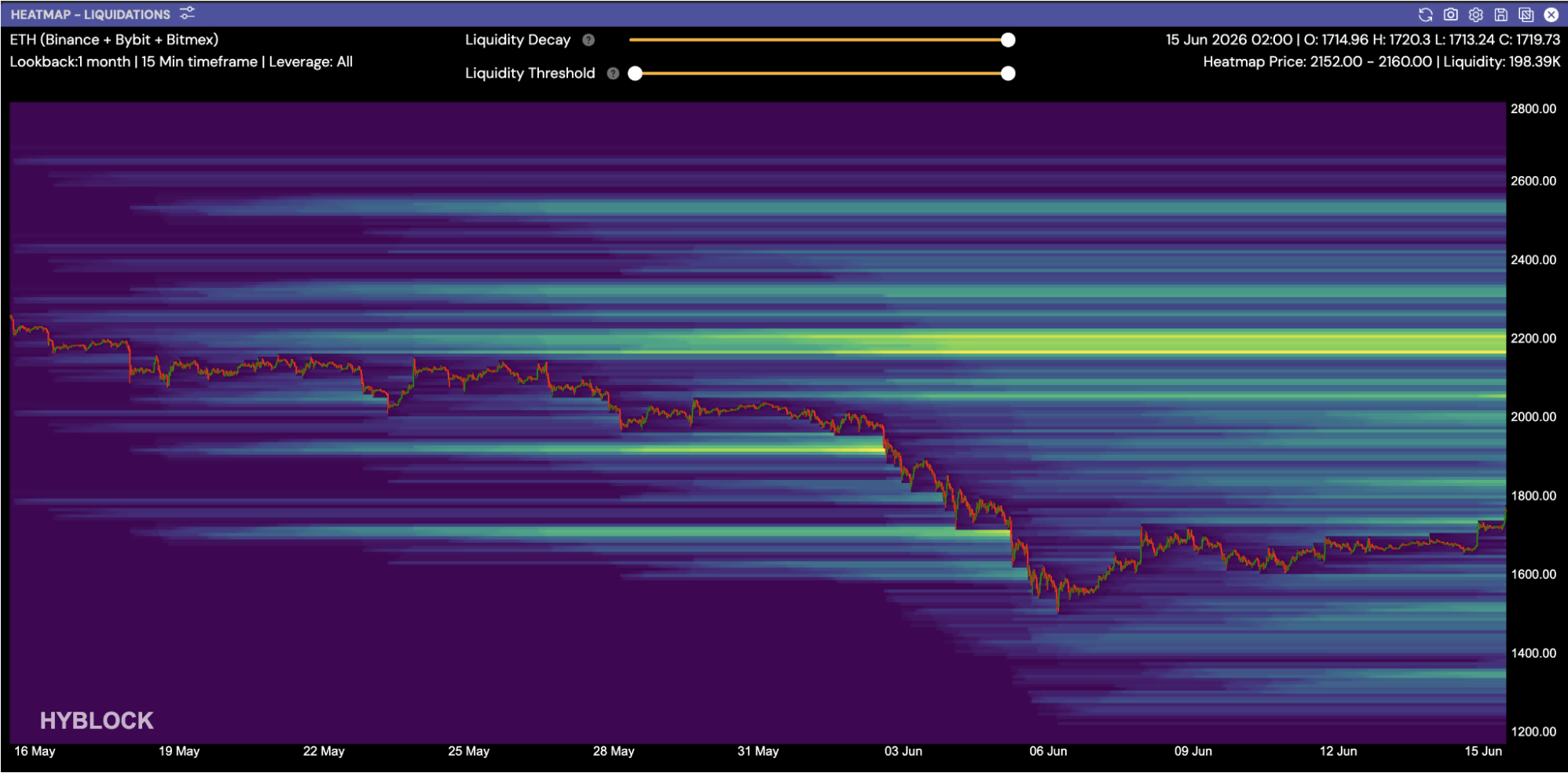
Support zone: $1,500
Key short term level: $1,850
Major upside liquidity target: $2,150
Ethereum has bounced, but remains weaker than Bitcoin.
ETH needs to reclaim and hold $1,850 before the short term structure improves. Until then, the move should be viewed as a tactical recovery inside a weaker broader trend.
The larger upside target remains $2,150, but Ethereum needs stronger relative strength and better network activity before that target becomes realistic.
For now, the allocation view remains to favor Bitcoin over Ethereum.
Altcoins
Altcoin exposure should remain selective.
There are interesting pockets of activity, especially around tokenisation, regulated on chain infrastructure, and pre IPO price discovery. However, this does not yet translate into a broad altcoin cycle.
Liquidity remains thin, stablecoin growth is negative, and Ethereum is not leading. That makes it difficult for altcoins to sustain broad based upside.
The better approach is to focus only on names with clear catalysts, strong product momentum, or specific market structure.
Disclaimer: This content presents objective market data and does not constitute investment advice.

Copyright © 2026 Rain Trading Limited