


Weekly Crypto Outlook – February 23, 2026
Bitcoin has broken below the critical $65,000 structural support, confirming the failure of the prior stabilization phase. Liquidity remains fragile as ETF outflows persist and macro uncertainty increases. Downside liquidity pools at $61,000 and $54,500 are now key levels to monitor.


TL;DR
Crypto markets have failed to transition from stabilization into recovery, with Bitcoin rejecting below the $71,500 liquidity zone and breaking below the critical $65,000 structural support. This breakdown confirms that the prior stabilization phase has failed, and downside liquidity pools at $61,000 and potentially $54,500 are now increasingly in play.
Macro and geopolitical developments have introduced additional uncertainty. The Fed Minutes and higher-than-expected PCE inflation confirmed a hawkish policy stance, while weaker GDP data reinforces late-cycle economic deceleration. At the same time, renewed tariff escalation and ongoing US–Iran tensions are introducing additional volatility risks.
Liquidity conditions remain extremely fragile. Trading volumes have collapsed across spot and derivatives markets, ETF outflows persist, and capital continues to leave the ecosystem. In this environment, price action remains liquidity-driven, and volatility is expected to remain elevated until structural recovery levels are reclaimed.
In This Week’s Note
Macro View
Market Movers and Events, Last Week
Key Macro Drivers, The Week Ahead
Market Outlook
Macro View
Macro uncertainty increases as hawkish policy meets slowing growth
This week’s macro developments introduced additional uncertainty into an already fragile market environment. The Federal Reserve Minutes confirmed that policymakers remain cautious and are not prepared to accelerate easing until disinflation progress is firmly established. Several participants even indicated that upward rate adjustments could be considered if inflation remains above target, reinforcing a hawkish risk assessment.
Inflation data reinforced this cautious stance. Core PCE inflation came in above expectations, with services inflation remaining persistent and goods inflation beginning to reaccelerate, partly reflecting tariff pass-through effects. This confirms that inflation risks remain asymmetric in the near term.
Growth data, however, is weakening. GDP came in significantly below expectations, reinforcing late-cycle deceleration dynamics. This combination of slowing growth and persistent inflation creates a stagflationary backdrop in the near term, increasing uncertainty across risk assets.
Geopolitical risks remain elevated. Tariff escalation and ongoing US–Iran tensions continue to increase volatility risk and reduce institutional risk appetite.
From a crypto perspective, Bitcoin remains primarily a liquidity-sensitive asset. Until macro clarity improves and liquidity stabilizes, markets are likely to remain fragile and volatility-driven.
Market Movers and Events, Last Week
Market data and flows
Crypto market cap: $2.31T, down 1.7% week-on-week
Average weekly volume: $86B, down 14%
Bitcoin weekly volume: $34.4B, down 21%
Ethereum weekly volume: $20.3B, down 5%
Ethereum network fees: 0.04 Gwei, reflecting extremely low activity
Spot trading volumes continue to collapse across major exchanges, confirming reduced participation and lack of conviction following the liquidation phase.
Since the Trump inauguration, crypto market cap has declined by approximately $1.3T, and Binance spot volumes have dropped by approximately 95%, highlighting severe liquidity contraction.
Futures and positioning
Bitcoin funding rate: 4.2%
Bitcoin open interest: $20.6B
Ethereum funding rate: 3.0%
Ethereum open interest: $10.2B
Positioning remains light overall, reflecting reduced leverage and weak conviction across derivatives markets.
ETF flows
Bitcoin ETF flows (7d): -$301M
Bitcoin ETF flows (30d): -$3.3B
Ethereum ETF flows (7d): -$113M
Ethereum ETF flows (30d): -$1.1B
ETF outflows continue to act as a liquidity headwind, though the pace has slowed.
Stablecoins and liquidity
USDT market cap: $183.6B, flat
USDC market cap: $74.4B, up 1.1%
Stablecoin net flows (30d): +$2.6B USDC minted
Stablecoin growth remains modest but shows early signs of stabilization. However, trading volumes remain low, indicating that liquidity conditions have not yet materially improved.
Total crypto liquidity has declined by approximately $19.4B year-to-date.
Dominance
Bitcoin dominance: 58.4%
Ethereum dominance: 10.2%
Bitcoin continues to outperform altcoins, reflecting defensive capital allocation.
Key headlines
Stablecoin infrastructure continues institutional expansion
Anchorage Digital launched a regulated stablecoin infrastructure platform allowing banks to issue and settle stablecoins under US regulatory oversight. This represents a major step toward integrating stablecoins into traditional financial infrastructure and reducing reliance on correspondent banking.
Société Générale deployed its MiCA-compliant EURCV stablecoin on the XRP Ledger, expanding euro-denominated stablecoin infrastructure and reinforcing growing institutional adoption of tokenized financial instruments.
The launch of the GENIUS Money Market ETF, with $17B in first-day volume, represents a major milestone in institutionalizing stablecoin reserve backing within regulated financial markets.
Traditional financial markets continue integrating crypto infrastructure
CME Group announced plans to introduce 24/7 crypto derivatives trading, reflecting continued institutional demand and alignment between traditional and crypto market structures.
Key Macro Drivers, The Week Ahead
Feb 25: President Trump speech Policy announcements or tariff developments could introduce volatility.
Feb 25: Nvidia (NVDA) earnings release Nvidia remains a critical bellwether for global risk appetite. Strong results would support risk assets, while disappointment could trigger broader risk-off pressure.
Feb 26: US–Iran talks in Geneva Geopolitical developments remain a key volatility catalyst.
Feb 27: Producer Price Index (PPI) Inflation data will influence Fed policy expectations and liquidity outlook.
Ongoing tariff escalation Trade tensions remain a major macro uncertainty and volatility driver.
Market Outlook
Sentiment
Extreme bearish sentiment persists, reflecting continued fragility in market confidence.
Bitcoin Greed & Fear Index: 5% (vs. 9% last week)
Ethereum Greed & Fear Index: 7% (vs. 10% last week)
Sentiment remains near extreme fear levels, confirming that investors continue to reduce exposure and avoid aggressive positioning.
Bitcoin
Bitcoin failed to reclaim key recovery levels and has now broken below the critical $65,000 structural support, invalidating the prior stabilization phase.
Key levels
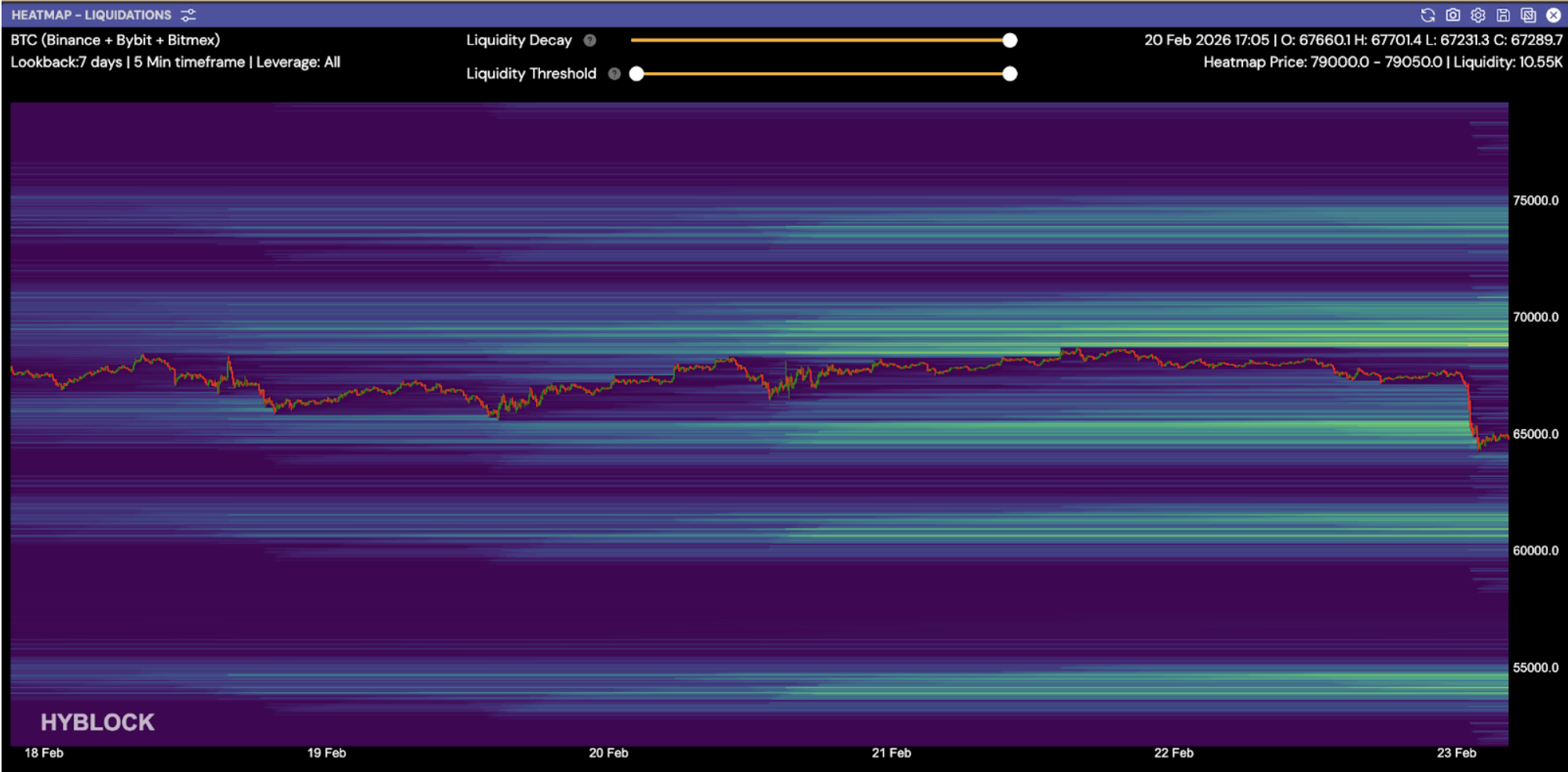
Current price: approximately $65,000
Liquidity pool to the upside: $68,900
Downside liquidity pools: $61,000 and $54,500
Recovery trigger: reclaim and sustained hold above $75,000
Base case
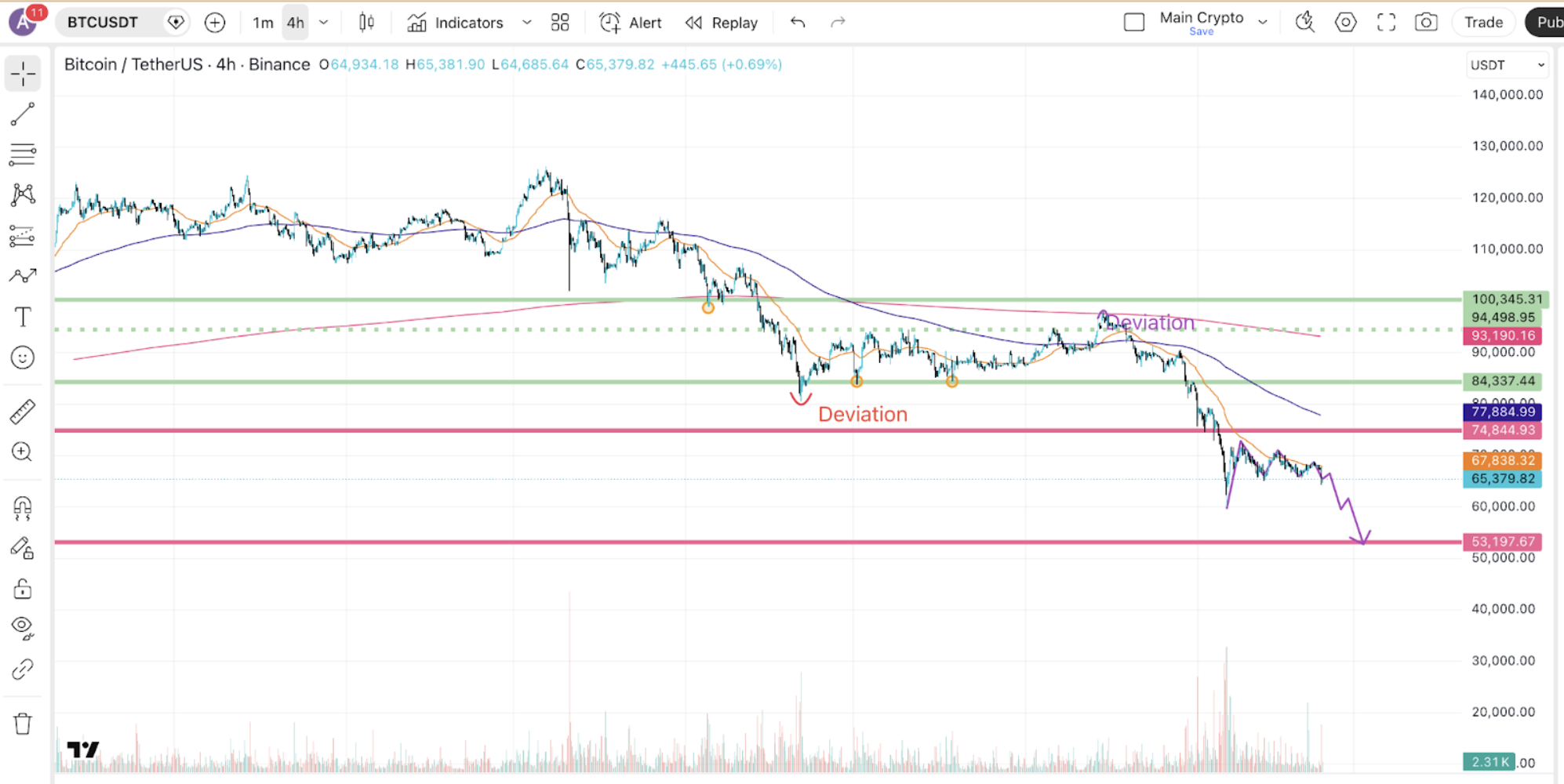
Bitcoin is likely to remain volatile and after last night drop below 65k we expect a short term consolidation in that zone with further weakness later on during the week with 61k and potentially lower liquidation pool very much in play.
Ethereum
Ethereum remains structurally weaker than Bitcoin and continues to underperform in the current liquidity-constrained environment.
Key levels
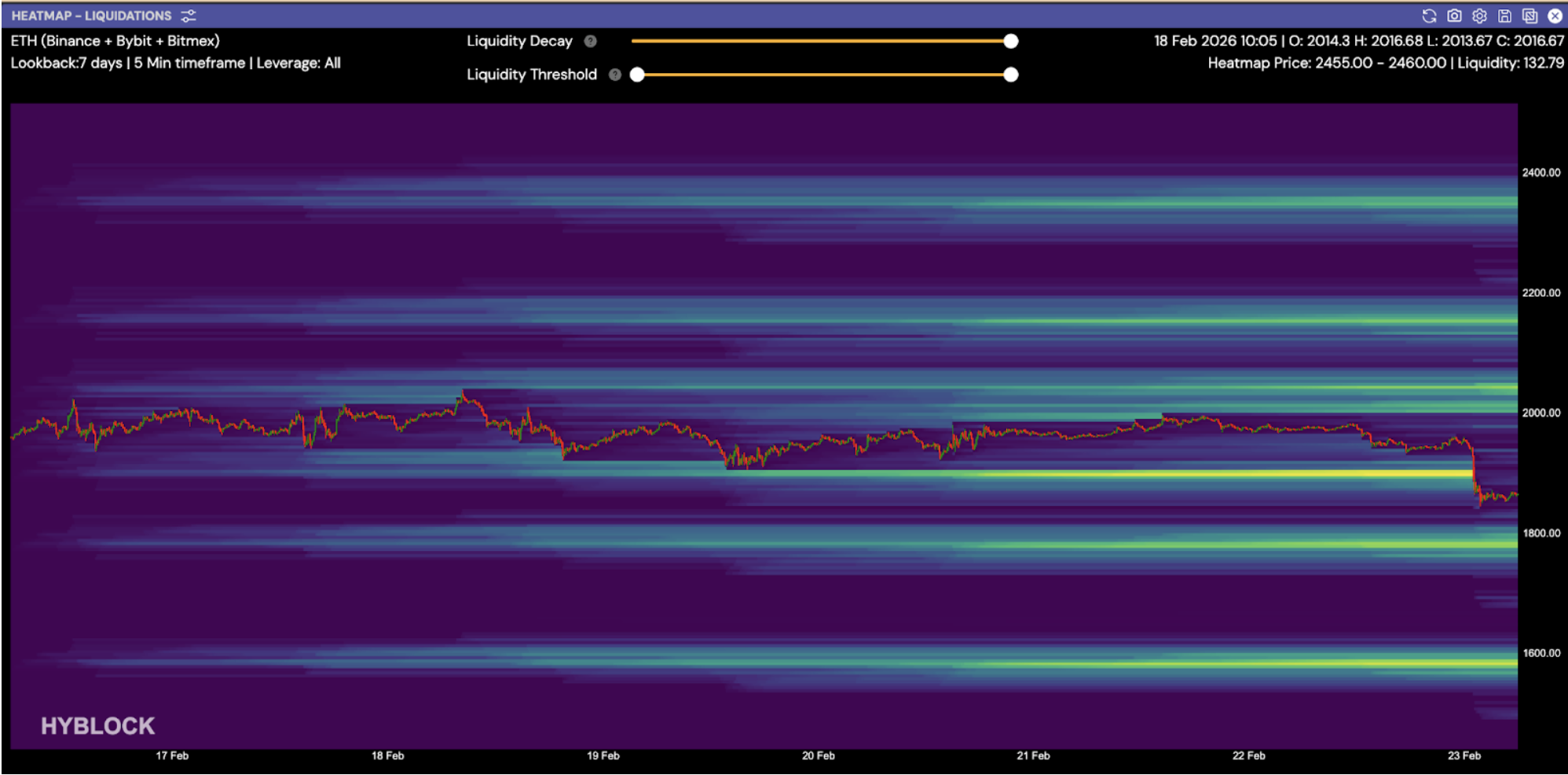
Current price: approximately $1,850
Liquidity pool to the upside: $2,040
Liquidity pool to the downside: $1,775 and $1,580
ETH will remain reactive to Bitcoin and broader liquidity conditions.
Altcoins
Altcoin performance remains fragile. Bitcoin continues to attract defensive capital allocation.
Disclaimer: This content presents objective market data and does not constitute investment advice.

Copyright © 2026 Rain Trading Limited