


Business Continuity Plan and Emergency Plan Implementation Procedure
1. Glosary of Terms and Definitions
Business Continuity (BC): The capability of the organization to continue delivery of products or services at acceptable predefined levels following disruptive incidents.
Business Continuity Management Lifecycle: The ongoing cycle of activities of the business continuity programme, that build organizational resilience.(GPG 2018)
Business Continuity Plan (BCP): Documented procedures that guide organizations to respond, recover, resume, and restore to a predefined level of operation following disruption.
Business Continuity Programme: The ongoing management and governance process supported by top management and appropriately resourced to implement and maintain business continuity management.
Business Continuity Requirements: The time frames and resources, and capabilities necessary to continue to deliver the prioritised products, services, processes, and activities following a disruption.
Business Impact Analysis (BIA): The process of analysing activities and the effect that a business disruption might have upon them.
Crises: A situation with a high level of uncertainty that disrupts the core activities and/or credibility of an organization and requires urgent action.
Contingency: A future event or circumstance which is possible but cannot be predicted with certainty.
Incident: A situation that might be, or could lead to, a disruption, loss, emergency or crisis.
Maximum Tolerable Period of Disruption (MTPD): The time it would take for adverse impacts, which might arise as a result of not providing a product/service or performing an activity, to become unacceptable.
Recovery Point Objective (RPO): The point to which information used by an activity must be restored to enable the activity to operate on resumption. RPO specifies the maximum amount of data an organization is willing to tolerate in the event of a data loss.
Recovery Time Objective (RTO): The period of time following an incident within which a product or service must be resumed, or activity must be resumed, or resources must be recovered.
2. Business Continuity Policy
2.1 General Introduction
This document outlines the business continuity plan (BCP) for Rain Kripto Varlık Alım Satım Platformu A.Ş. [hereinafter referred to as the “Rain”] operating in the core business of crypto asset trading brokerage and custody.
Rain is committed to provide the best possible experience to its customers and aspires to be the world’s most reliable crypto trading platform. To ensure the high availability of its platform and services, Rain has developed a holistic approach towards identifying potential threats to its prioritized services and the impacts to business operations those threats, if realized, might cause, and which provides a framework for building organizational resilience with the capability of an effective response.
Rain, like any other business, is exposed to disruptions to critical business functions and or its critical infrastructure and hence the delivery of services to its customers. Our strategy in continuing business in the event of an incident is to ensure the safety and security of our customer’s funds, data, and to continue providing our prioritized services with minimal disruptions as possible through pre-defined alternate arrangements.
Rain shall maintain and regularly review contingency plans to enable them to set up alternative arrangements, with minimum disruption to business.
2.2 Scope
This programme is an ongoing cycle of activities that implements the policy, and is applicable to the primary business functions within Rain with main focus on prioritized services that deliver beneficial outcomes to the customers. More specifically to the followings;
Front Office Operations
- Customers Onboarding
- Customers Accounts Management Services
Back Office Operations
- Customer Fund Deposits
- Customer Fund Withdrawals
- Crypto Assets - Card Buys
- Crypto Assets - FIAT buys and sells
- Crypto Assets - Send and Receive and Custody Services
Customer Experience and Community Management
- Attending Customers’ Enquiries via Email
- Attending Customers’ Enquiries via Live Chat
- Attending Customers’ Enquiries via Social Media Channels
Rain Platform
The above prioritized services make significant contributions to Rain’s reputation, income, and success.
As part of the ongoing review and implementation process, the programme shall consider extending to other secondary support and control functions such as HR, Legal and finance among others, where and when appropriate.
The plan doesn't include pandemic planning as the vast majority of employees are working remotely and are well diversified among various countries.
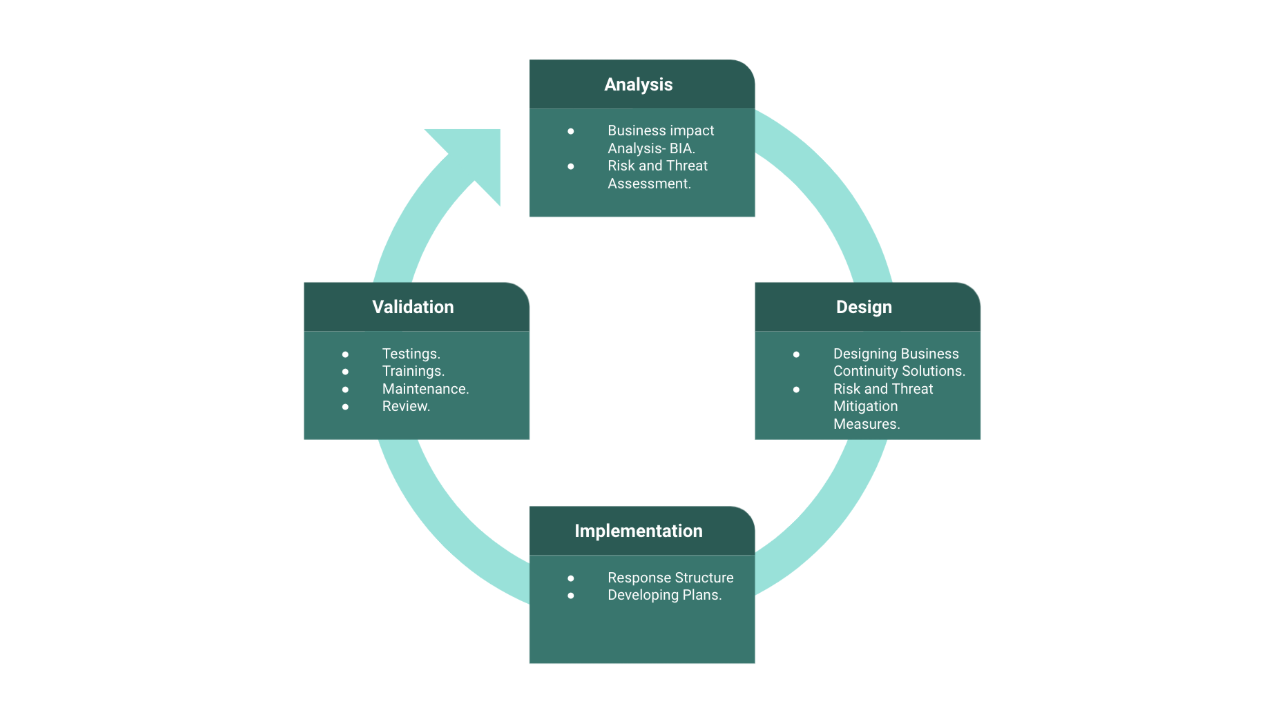
The ongoing business continuity cycle consists of the activities reflected in below figure:
2.3 Amendments and update of the manual
Rain is a fast growing organization and hence the scope of this programme shall be reviewed periodically (minimum annually) to accommodate for any new changes and requirements;
Changes to the document may be initiated under the following circumstances:
- A change in the organization’s approach to risk which can be prompted by (but not limited to) an incident or change.
- A change in market conditions.
- Changes to products or services (including those that are outsourced).
- Changes to legal or regulatory requirements.
Proposed changes or amendments must be initiated by the Head of Risk and must be reviewed by the CTO and CISO for their comments and views if any. After these are incorporated, the same would be sent for the approval of the GM and the Board of Directors.
2.4 Effective Date
This manual is effective from the date of its approval by the Board of Directors.
2.5 Access and Confidentiality
The access to this manual shall be restricted to internal use and to relevant personnel.
3. Governance, Roles and Responsibilites
3.1 Governance and Structure
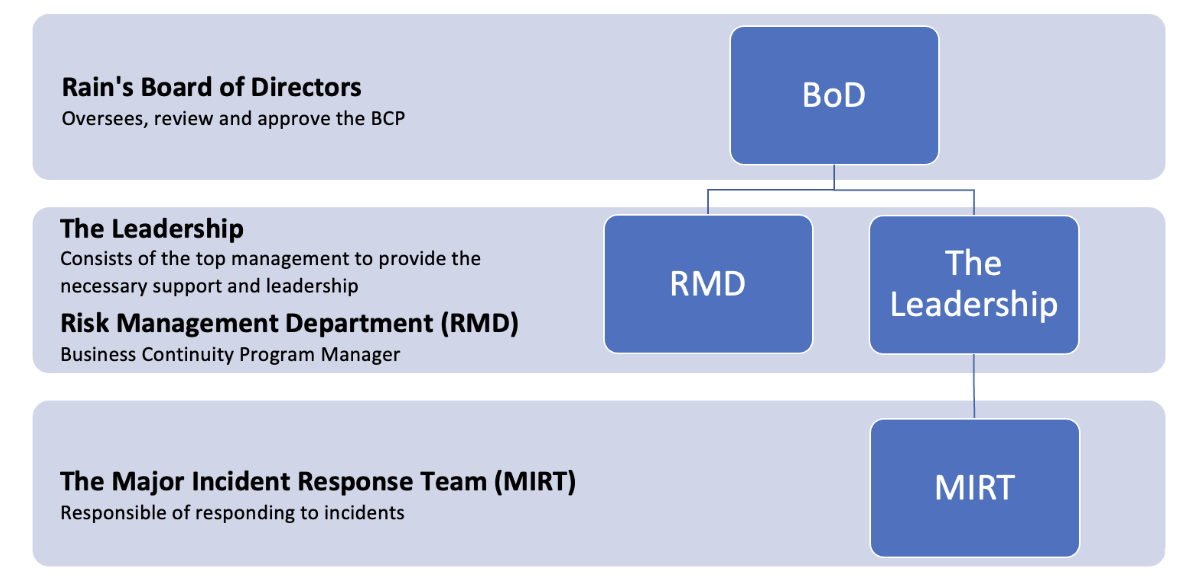
The governance structure of the business continuity program (BCP) is reflected below:
3.2 Roles and responsibilities
All personnel, regardless of their level, are responsible for helping to identify, prevent, alert and control any threats in their work domain that can cause potential risk to the continuity of the business. Certain managers and employees have specific responsibilities, which are further defined within job descriptions, departments charters and/or other policies and procedure manuals.
The following section highlights the roles and responsibilities of various functions within the company.
3.2.1 The Board of Directors (BoD)
The board of directors is responsible for ensuring that management designs and implements an effective Business Continuity Program by:
- Overseeing and exercising strategic level visibility and oversight over business continuity programmes and progress.
- Setting the foundation for continuity planning success by promoting a company culture that recognizes the value of well-managing risk.
- Monitoring and reviewing the business continuity programme regularly to ensure the requirements are being met.
- Allocating adequate resources and budgets towards the programme.
- Understanding Company’s business continuity risks and potential impacts.
- Define Company’s level of comfort and risk appetite with regard to the mitigations and controls.
- Periodically reviewing and authorizing the BCP.
3.2.2 The leadership
Consists of top management with the following main responsibilities:
- Provide leadership, commitment, and advice.
- Manage the business continuity programme.
- Ensure the business continuity programme aligns with the Rain’s Objectives Key Results (OKRs).
- Decide on business continuity scope and priorities.
- Ensure the business continuity programme complies with the business continuity policy and any related legal and regulatory requirements.
- Establish the external communication strategy and message statements to be shared with the customers and the public via (social media accounts, email, SMS, Live Chat, etc...) and the authorities and regulatory bodies via formal Phone/Email.
- Review business continuity and recovery plans and ensure that the business continuity plan adequately reflects the organization’s business continuity capability.
- Support continuous improvements.
- Monitor the business continuity programme implementation and testing.
- Supervise and provide the incident response team with strategic guidance and decisions during an incident/crises including the approval of external communications.
3.2.3 The Risk Management Department (RMD)
- Conduct and facilitate business impact analysis and risk and threat assessment in coordination with various business units.
- Facilitate the discussions with regard to solution designing, implementation and testing.
- Develop and deliver an effective business continuity programme. This includes facilitation and coordination of plans throughout the organization.
- Coordinate the implementation of the business continuity policy and programme and report to the leadership and BoD.
- Provide regular updates to BOD on BCP implementation results.
3.2.4 The Major Incident Response Team (MIRT)
Due the nature of Rain’s business, the MIRT mainly consists of pre appointed expert personnel in the fields of technology and security to respond to incidents, but could also include other personnel who are key in their respective roles and are required to work in conjunction with the technology and security experts and under the direction of the leadership team to assist in various phases of recovery efficiently and effectively and to bring the operations back to normal situation.
Depending on the incident type and nature the leadership will allocate required resources and experts from relevant departments to work in conjunction with the technology and security personnel.
- Follow the incident response and recovery plans outlined in section 8 of this document.
- Implement any fallback facilities, alternative software facilities or any other means being manual or otherwise for the continuation of clients support and services, including the integrity of data recovered as well as identification of any changes or new data compiled during the recovery periods.
- Implement what has been agreed by the leadership.
- Monitor the process to ensure appropriate implementation.
- Report results back to the leadership and seek ways to improve in future.
- Document a post incident analysis and procedure for audit and future use in improving recovery procedures.
4. Contingency Planning
A contingency plan is a proactive strategy which describes the course of actions that the management and staff need to take in response to an event that could happen in the future. It plays a significant role in business continuity, risk management and disaster recovery.
4.1 Steps in Contingency Planning
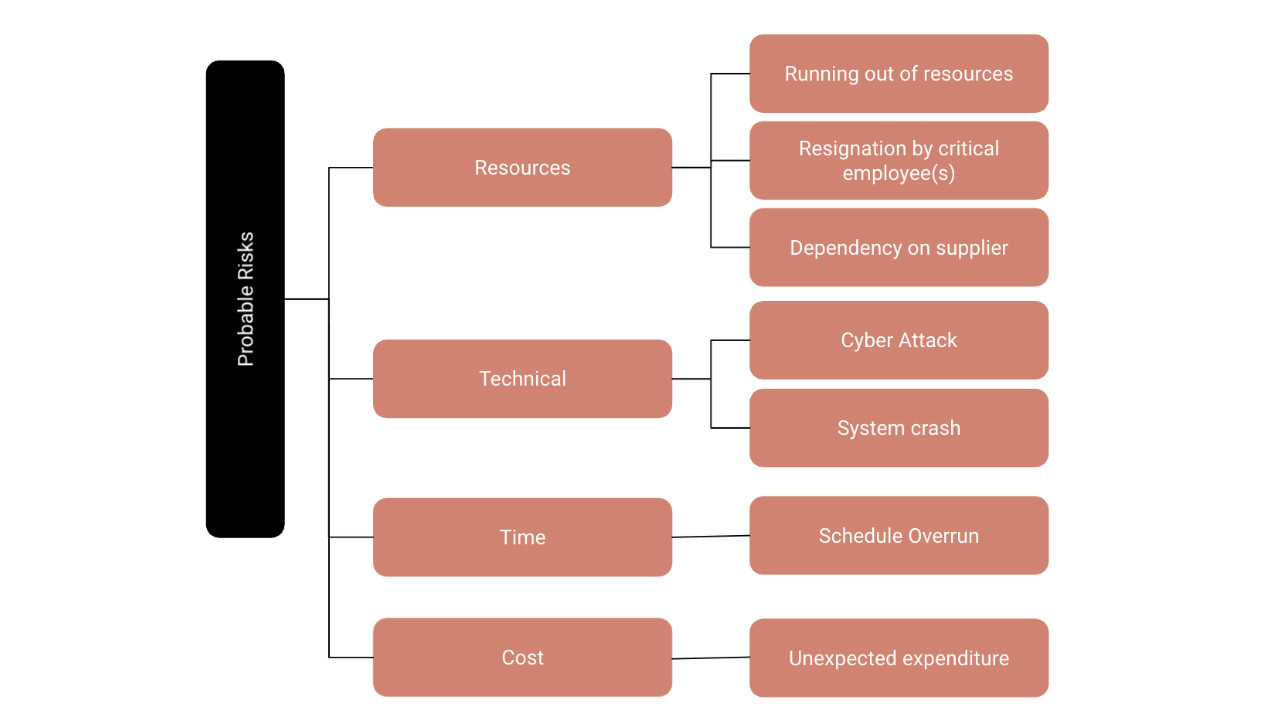
4.1.1 Identification of Risks
Firstly, identify the major events that could have a negative impact on Rain business and on the key resources, such as Rain platform, employees, machines, IT systems, etc.
4.1.2 Impact Analysis
After identifying the list of all the possible risks that could occur in different areas of Rain business, start prioritizing them based on the threat they pose.
4.1.3 Create Contingency Plans for Each Event
In this step, we need to create separate plans that outline the actions we need to take in case the risks we identified earlier occur. Consider what needs to be done in order to resume normal operations after the impact of the event.
Ensure to clarify employee responsibilities, timelines that highlight when things should be done and completed after the event, restoring and communications processes and the steps you need to have taken in advance to prevent losses when the event has taken place (i.e. insurance coverage).
5. Business Impact Analysis (BIA)
This stage of the programmes aimed at exploring how various departments at Rain function and challenges its operations.
The outcome of the BIA determines the priority of the business activities and the associated resources/dependencies required to ensure operational resilience and continuity of operations during and after a business disruption. The BIA quantifies the impacts over time of disruptions on service delivery, risks to service delivery, the maximum tolerable period of disruption (MTPD), recovery time objectives (RTOs) and recovery point objectives (RPOs).
The resources/dependencies are assessed in terms of:
- ICT applications,
- External suppliers/partners,
- Internal dependencies,
- Key personnel and manpower.
Services are grouped into tiered sets by Importance, ranging from mission-critical (1st priority), business critical (2nd priority), important (3rd priority) and deferrable (4th priority).
Given the dynamic business nature of Rain, the BIA exercise shall preferably be refreshed annually or following major organizational or information technology changes.

Copyright © 2026 Rain Trading Limited