




TL;DR
Crypto enters the new week with the market still defined by risk management rather than conviction. The macro backdrop has become more hostile, geopolitical risks are still rising, and flows have deteriorated further. Bitcoin has now lost key near-term support, while Ethereum has already broken below its equivalent threshold, leaving both assets vulnerable to another leg lower if the risk environment worsens.
The key change from last week is that ETF flows have flipped from support to drag. Stablecoin data also remains unsupportive, with minting still weak and net liquidity contracting. At the same time, the market is increasingly pricing not a short inflation shock, but the risk that the current geopolitical crisis evolves into a broader growth shock. Recent PMI data already points in that direction, with resilient manufacturing offset by a clear slowdown in services, softer employment, and a sharp increase in input prices.
For Bitcoin, after dipping toward $65,000 overnight, price is now trading back around $67,000. However, last night’s move has materially increased the risk of a deeper extension toward $60,000 if the market fails to rebuild momentum quickly. For Ethereum, the situation remains weaker, with price already trading below the equivalent support zone, increasing the risk of fresh year-to-date lows unless there is a sharp and credible de-escalation in the Middle East.
In This Week’s Note
Macro View
Market Movers and Events, Last Week
Key Macro Drivers, The Week Ahead
Market Outlook
Macro View
Macro remains in control, and the market is no longer getting enough support from flows to offset it.
The latest PMI data reinforced the idea that the U.S. economy is entering a more difficult mix. Manufacturing surprised to the upside at 52.4, but services slowed to 51.1, the weakest reading in 11 months, while the composite slipped to 51.4.
More importantly, input prices jumped sharply as energy and shipping disruptions fed through the system, while employment in the private sector contracted for the first time in more than a year. That combination points to a more stagflationary setup, with slower growth and renewed inflation pressure arriving at the same time.
That matters for crypto because the old assumption that weaker growth automatically means easier policy is no longer clean. If inflation remains under pressure from higher energy prices and disrupted supply chains, the Fed may have less room to respond quickly even as activity softens.
Geopolitics also remain a direct market driver. The conflict has expanded beyond the initial US-Iran framework, with Lebanon and the Red Sea now increasingly relevant through Hezbollah and Houthi involvement. The market is now also beginning to price the possibility of US troops on the ground, which is contributing to the broader risk-off tone.
At the same time, one macro risk that cannot be ignored is the possibility of a sudden political shift where Trump declares victory and exits, as seen in past episodes. Even if this remains unlikely in the near term, markets remain highly sensitive to abrupt political headline reversals, and in the current low-liquidity environment such a development could quickly flip sentiment and trigger a violent repricing across risk assets, including crypto.
Taken together, this is still an environment where rallies are difficult to trust, particularly in a market with weak participation and deteriorating liquidity.
Market Movers and Events, Last Week
Market data and flows
Crypto market cap: $2.3T, down 1.7% week on week
Average weekly volume: $90B, 7% below average
Bitcoin weekly volume: $38.2B, 5% below average
Ethereum weekly volume: $18.3B, 18% below average
Ethereum network fees: 0.12 Gwei, still indicating low network usage
The broad message is the same as last week, but weaker. Participation remains thin, and the market is struggling to generate durable momentum.
Futures and positioning
Bitcoin funding rate: 1.5%
Bitcoin open interest: $21.5B, up $100M
Ethereum funding rate: 2.8%
Ethereum open interest: $11.8B, up $100M
Some futures traders are trying to buy the dip, but conviction remains low.
ETF flows
Bitcoin ETF flows (7 days): -$297M
Bitcoin ETF flows (30 days): $1.4B
Ethereum ETF flows (7 days): -$208M
Ethereum ETF flows (30 days): -$119M
This is one of the most important changes this week. BTC ETF flows have flipped from a partial support to a headwind, while ETH continues to see persistent demand weakness.
Stablecoins and liquidity
USDT market cap: $184.2B, up 0.05%
USDC market cap: $77.7B, down 1.5%
Weekly net stablecoin change: -$1.1B
Total minted over last 30 days: $0.8B
Liquidity remains a clear concern. Stablecoin expansion is not supporting a bullish narrative.
Dominance
Bitcoin dominance: 58.0%
Ethereum dominance: 10.5%
Key headlines
Crédit Agricole prepares to launch a euro-denominated stablecoin
Crédit Agricole, Europe’s second-largest banking group with €2.4T in assets, is preparing a euro stablecoin launch for this summer. The initial use case is expected to focus on intra-group liquidity management across its 40 regional banks and subsidiaries, including Amundi, with broader institutional use cases likely to follow. This adds to the growing momentum behind bank-led stablecoin adoption in Europe under MiCA.
Franklin Templeton and Ondo bring 24/7 tokenised ETF trading to crypto wallets
Franklin Templeton and Ondo are bringing 5 tokenised ETFs on-chain, spanning growth equities, large cap, fixed income, equity income, and gold. The products can be traded directly from crypto wallets on Ondo Global Markets, which now reports more than $620M TVL and over $12B in cumulative trading volume. The development continues to reinforce tokenisation as one of the strongest real-world adoption themes in crypto.
UK bans crypto donations to political parties
The UK government has imposed an immediate moratorium on crypto donations to political parties following concerns around foreign financial interference and the difficulty of tracing overseas flows. While framed as a temporary pause, it reinforces that politically sensitive crypto use cases remain vulnerable to abrupt regulatory intervention.
Key Macro Drivers, The Week Ahead
Apr 1: ADP Employment Change (Consensus: 42K) - A softer print would reinforce the idea that labor momentum is fading and strengthen the growth-shock narrative.
Apr 1: Retail Sales (MoM) (Consensus: +0.4%) - This will be important for judging whether consumer demand is beginning to soften under the weight of higher energy prices and weaker confidence.
Apr 1: ISM Manufacturing PMI (Consensus: 52.3) - After last week’s stronger S&P manufacturing print, this release will test whether industrial resilience is proving durable despite geopolitical disruption.
Apr 3: Nonfarm Payrolls (Consensus: 49K) - This is the key macro event of the week. A materially softer print would reinforce the stagflation and growth-shock narrative, while a stronger number may briefly support risk assets but also keep higher-for-longer concerns alive.
This is an important macro week because softer labor data would strengthen the growth-shock narrative now emerging in markets.
Token Unlocks
Mar 30: Kamino (KMNO), 229M tokens, ~$4M
Mar 30: Zora (ZORA), 167M tokens, ~$2.5M
Mar 31: Optimism (OP), 31.34M tokens, ~$3.2M
Apr 1: Sui (SUI), 42.94M tokens, ~$37.2M
Apr 1: EigenCloud (EIGEN), 36.82M tokens, ~$6.3M
Market Outlook
Sentiment
Bitcoin Greed and Fear Index: 20%, down from 26% last week
Ethereum Greed and Fear Index: 35%, down from 44% last week
Sentiment continues to weaken week on week, reflecting a market with low conviction, deteriorating liquidity, and limited willingness to add risk ahead of macro data and geopolitical uncertainty.
Bitcoin
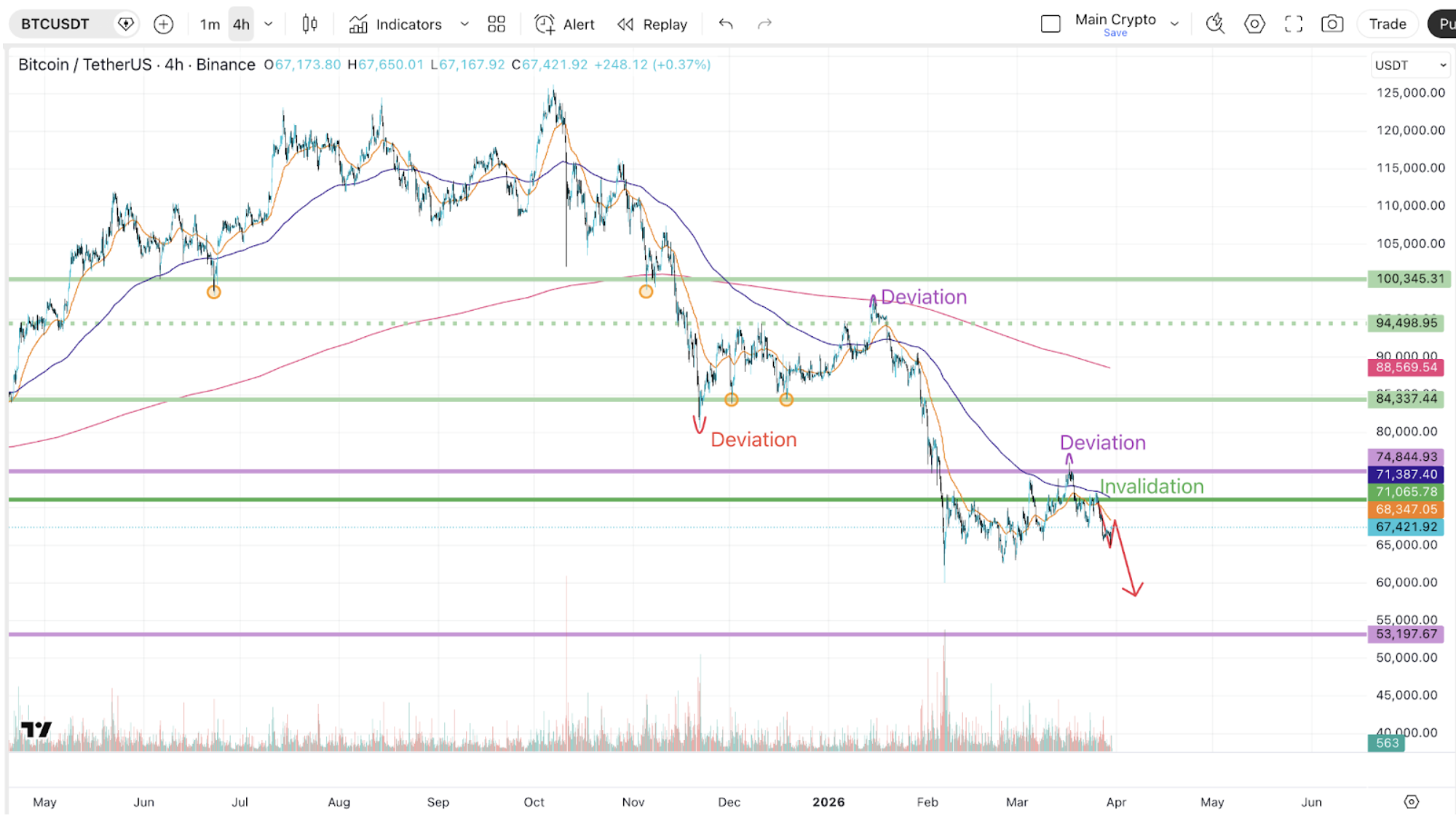
Last week’s scenario played out almost perfectly, with an early move higher clearing the $71,000 zone before weakness resumed and price rotated back toward the $65,000 area.
For this week, the overnight dip toward $65,000 has further increased the probability of a move toward $60,000.
The most likely scenario from here is that the current relief rally fails below the $68,300 resistance zone, followed by a renewed move toward $65,500. Below that, notable downside liquidation pools sit at $64,400 and $57,200, with a break through the first cluster likely accelerating the move toward sub-$60,000 levels, particularly if macro data disappoints or geopolitical headlines deteriorate further.
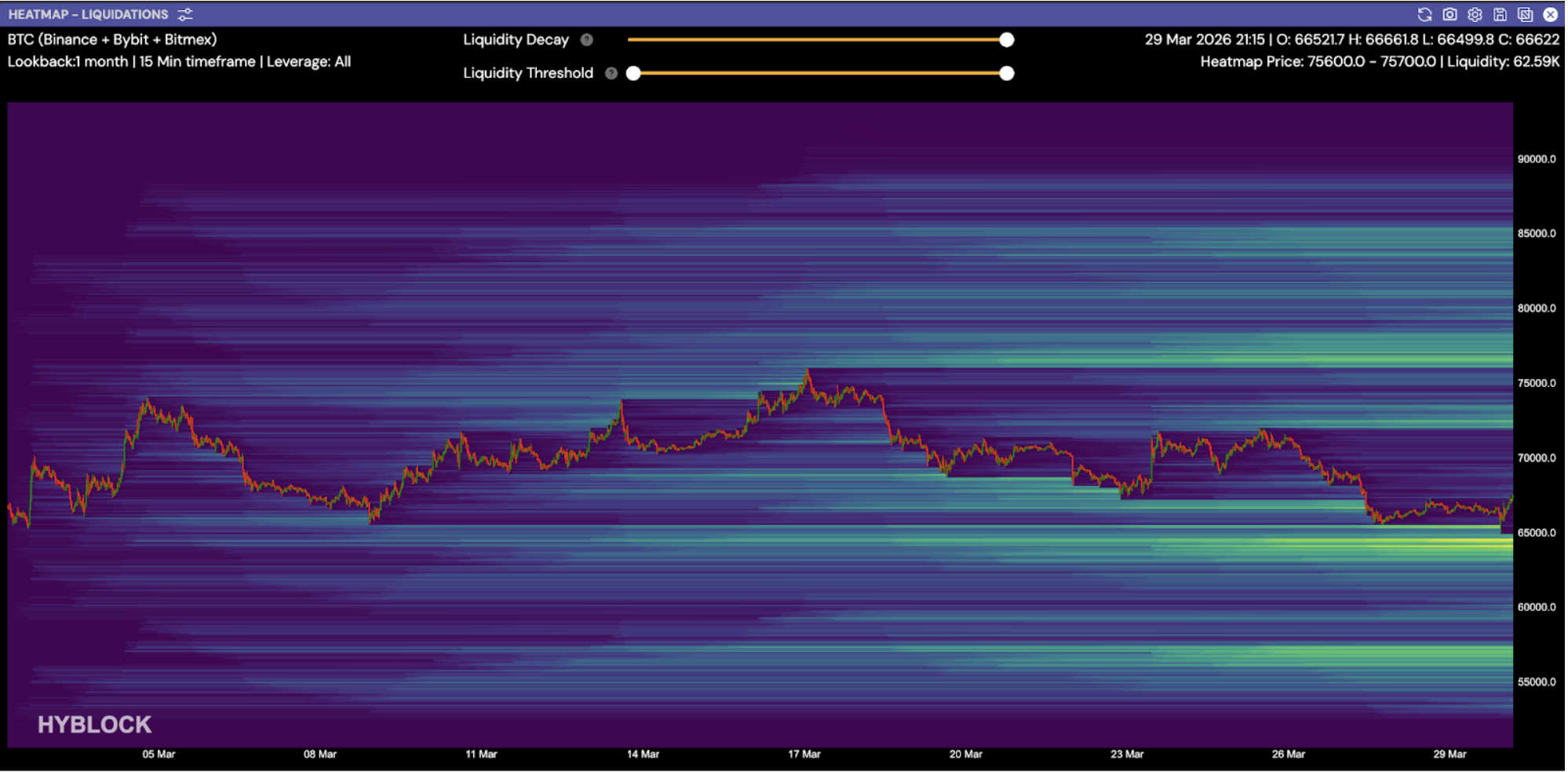
Immediate resistance: $68,300
First downside target: $65,500
Downside liquidation pools: $64,400 and $57,200
Extension target: sub-$60,000
Major invalidation zone: $71,000
Ethereum
Ethereum remains materially weaker than Bitcoin and continues to trade with a heavier downside bias.
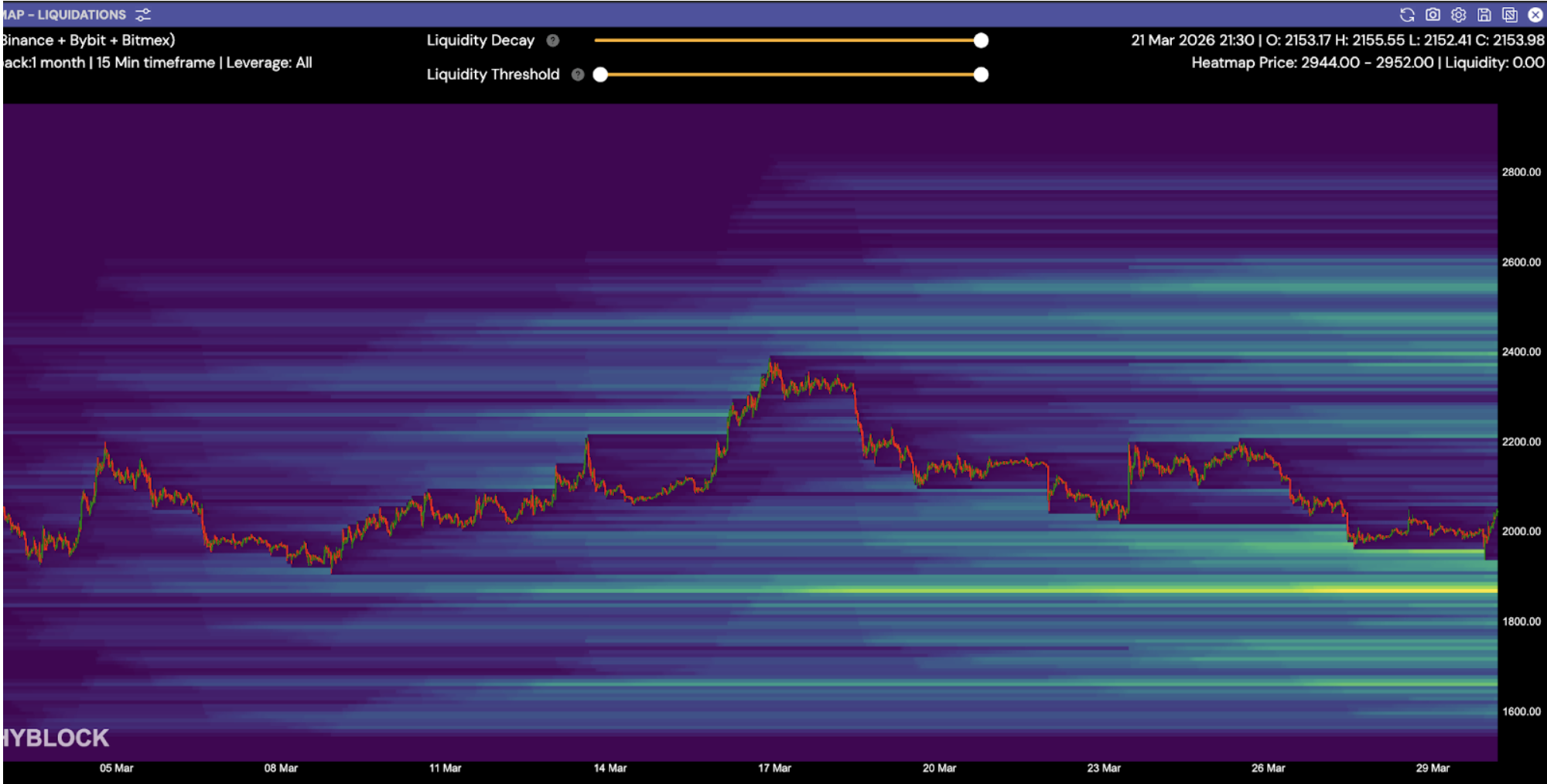
Immediate resistance: $2,075
First downside target: $1,975
Downside liquidation pool: $1,865
Major invalidation zone: $2,200
The broader structure remains vulnerable, with downside risks likely to accelerate if Bitcoin loses its nearby support zones.
Altcoins
The model favors Bitcoin over altcoins until uncertainty is resolved.
Broad beta exposure still looks unattractive in current conditions.
Disclaimer: This content presents objective market data and does not constitute investment advice.

Copyright © 2026 Rain Management W.L.L.