


Weekly Crypto Outlook - June 22, 2026
Crypto markets remained broadly flat as investors absorbed the Fed’s higher-for-longer stance and improving but fragile geopolitical conditions. Bitcoin showed relative resilience, but continued ETF outflows and weak stablecoin liquidity are limiting the strength of any recovery.

TL;DR
Crypto markets were broadly flat last week, but the market absorbed a hawkish Fed reset better than expected.
Total crypto market cap stands at $2.19T, down 0.9% from last week. Volumes remain soft, with average weekly volume around $67B, 12% below average. Bitcoin volume was $24.7B, 18% below average, while Ethereum volume was $11.1B, 13% below average.
The Fed left its policy rate unchanged, keeping the target range at 3.5% to 3.75%. This was not a dovish hold. The statement and projections reinforced a higher for longer stance, while Kevin Warsh's first meeting as Fed Chair confirmed a move toward less forward guidance and more data dependence.
The geopolitical backdrop is also improving, but remains fragile. The latest U.S. and Iran talks in Switzerland produced a 60 day roadmap toward a final agreement, with focus on keeping the Strait of Hormuz open and managing regional flashpoints. This reduces oil shock risk, but implementation remains the key test.
Bitcoin remains exposed to rate repricing in the short term, but the reaction was more resilient than expected. U.S. equities sold off sharply after the Fed, while Bitcoin's decline was relatively contained.
ETF outflows remain the key problem. Bitcoin ETFs have now seen around $6B in outflows since the May CPI print, with another $142M of outflows over the last 7 days. Without institutional buying, rallies remain difficult to sustain.
Sentiment continues to recover. Bitcoin Greed and Fear improved to 35% from 17% last week, while Ethereum improved to 30% from 16%. This supports a more constructive tactical setup, but does not yet confirm a durable trend reversal.
The preferred scenario is that Monday marks the high of the week, followed by a slow move back toward the low of the range. Invalidation would be stabilization above $64.9K, which would open the door to a recovery toward a new local top around $68.5K.
In This Week's Note
Macro View
Market Movers and Events, Last Week
Key Headlines
Key Macro Drivers, The Week Ahead
Notable Token Unlocks
Market Outlook
Strategy Note
Macro View
Macro remains the main driver for crypto.
The key event last week was Kevin Warsh's first meeting as Fed Chair. The Fed left its policy rate unchanged, keeping the target range at 3.5% to 3.75%, but the tone was not dovish. The statement stressed that activity remains solid, uncertainty is elevated, and inflation is still above target partly because of energy related supply shocks.
The June projections reinforced a higher for longer message. The median end 2026 fed funds rate was projected at 3.8%, with 2027 at 3.6%. That keeps real rate expectations restrictive and remains a headwind for liquidity sensitive assets such as Bitcoin.
Warsh also made clear that he favors less Fed choreography and more genuine data dependence. This matters because it reduces the amount of forward guidance markets can rely on. In practice, that could mean more volatility around incoming data and Fed communication.
For Bitcoin, the picture is mixed. Higher real rate expectations are still negative in the short term, so the initial hawkish interpretation made sense. At the same time, persistent inflation, policy uncertainty, and a Fed that is now signaling less and reacting more all continue to strengthen Bitcoin's longer term monetary case.
What stands out is resilience. U.S. equities reacted poorly to the Fed, with the S&P 500 down around 1.2% and the Nasdaq down around 1.3%. Bitcoin fell around 1.6%. That is not strong price action in absolute terms, but it is more resilient than expected given the hawkish reset and reduced policy visibility.
The geopolitical backdrop has also improved, but remains fragile. The latest U.S. and Iran talks in Switzerland produced encouraging progress, with Qatar and Pakistan pointing to a 60 day roadmap toward a final agreement. The discussions appear focused on keeping the Strait of Hormuz open, managing the Lebanon front through a de-confliction mechanism, and creating a path for further negotiations on nuclear issues and sanctions relief.
For markets, this is cautiously positive. If the roadmap holds, it reduces the immediate oil shock risk and removes part of the inflation pressure that has been weighing on Bitcoin. However, this is not yet a final peace deal. Technical talks are still ongoing, tensions remain around Lebanon and Hormuz, and nuclear parameters still need to be negotiated. The first real test will be whether the new de-confliction process can prevent renewed escalation on the ground.
This is not a setup for aggressive optimism, but it is also not a capitulation setup. The better framing is cautious constructiveness. Crypto still needs institutional flows to stabilize, but the market is absorbing bad macro news better than it did earlier in June.
Market Movers and Events, Last Week
Market data and flows
Crypto market cap: $2.19T, down 0.9% WoW
Average weekly volume: $67B, 12% below average
Bitcoin weekly volume: $24.7B, 18% below average
Ethereum weekly volume: $11.1B, 13% below average
Ethereum network fees: 0.12 Gwei
Crypto markets were mostly flat last week, and volumes stayed low.
The lack of volume shows that the market has not returned to strong accumulation. However, the fact that crypto held up reasonably well after a hawkish Fed reset is encouraging. The market looks fragile, but less fragile than it did earlier this month.
Dominance and rotation
Bitcoin dominance: 58.4%, down 0.4% WoW
Ethereum dominance: 9.5%, up 0.3% WoW
Bitcoin remains the preferred exposure if crypto exposure is required.
Ethereum dominance improved slightly, but not enough to confirm a broad altcoin rotation. The setup still favors Bitcoin over altcoins, while traders should keep overall exposure limited until flows improve.
Stablecoins and liquidity
USDT market cap: $186.4B, down 0.05% WoW
USDT volume: $57.7B, 11% below average
USDC market cap: $74.7B, flat WoW
USDC volume: $8.4B, 22% below average
Stablecoin minting indicator: 41st percentile
30 day stablecoin off ramp: $4.5B
Stablecoin liquidity remains weak, but the picture is less negative than earlier in June.
The minting indicator has moved back to neutral, which is an improvement. However, the 30 day off ramp remains meaningful, and stablecoin volumes are still below average. A stronger market recovery needs stablecoin supply to stop shrinking and eventually grow again.
ETF and institutional flows
Bitcoin ETF outflows continue to weigh on the market.
Bitcoin ETFs saw $142M of outflows over the last 7 days, compared with $4.3B over the previous 30 days. Since the May CPI print, Bitcoin ETFs have seen around $6B of outflows, including around $400M since the June 10 CPI print.
This explains why Bitcoin has struggled to rebound. Without institutional buying, technical recoveries are difficult to sustain.
Ethereum ETF flows remain weak as well. Ethereum saw $14M of outflows over the last 7 days and $571M over the previous 30 days. This reinforces the view that Ethereum has not yet built a strong relative strength case.
Technical picture
Bitcoin short term technicals are modestly constructive, but not strong enough on their own.
Bitcoin RSI stands at 39%, while Stochastics stand at 50%. The current trend remains bearish below $66,788. The key short term bullish or bearish reference level is $63,625, while the major bull or bear level is $70,523.
This supports a tactical recovery setup, but only if flows improve. Without ETF inflows or stronger stablecoin liquidity, rallies remain vulnerable.
Sentiment
Bitcoin Greed and Fear: 35%, up from 17% last week
Ethereum Greed and Fear: 30%, up from 16% last week
Sentiment continues to recover from panic levels. This is supportive for a tactical bounce, but not yet a confirmed trend reversal.
Key Headlines
Ethereum Foundation leadership pressure increases
The Ethereum Foundation lost its second co executive director in four months. Hsiao Wei Wang stepped down on June 18 following a sabbatical, after Tomasz Stanczak's resignation earlier this year.
The timing is sensitive because former EF contributor Trent Van Epps warned that Ethereum could face a slow burning funding issue over the next three to nine months. He estimates that maintaining core client teams and protocol coordination requires around $30M annually.
The concern is not immediate protocol risk, but governance and funding uncertainty. At least nine senior contributors have reportedly departed the EF in 2026, and the April expiry of the Client Incentive Program has not yet been replaced.
For Ethereum, this adds to an already weak relative picture. ETH has improved slightly, but leadership, funding, and network activity concerns remain a headwind.
CME plans to sue the CFTC over perpetual futures approval
CME Group CEO Terrence Duffy said the exchange intends to sue the CFTC after the regulator approved Kalshi's perpetual futures product.
CME argues that the product does not meet the Dodd Frank definition of a futures contract and should instead be treated as a swap. The exchange also said it needs more regulatory clarity before considering perpetual futures products of its own.
This matters because perpetual futures are one of the most important crypto native market structures. If U.S. regulated venues eventually move into perpetuals, it could be a major institutional catalyst. For now, the dispute shows that the regulatory framework remains unsettled.
Fidelity enters the stablecoin reserves race
Fidelity launched the Fidelity Reserves Digital Fund on June 17, a money market fund designed to manage reserve assets for stablecoin issuers under the GENIUS Act's reserve requirements.
The fund invests in short term U.S. Treasuries, cash, and overnight repos. The move follows a similar product from State Street.
This is structurally positive for stablecoins. Large asset managers are positioning for institutional stablecoin adoption, and reserve management is becoming a competitive institutional market. Stablecoins remain a roughly $320B market, with some industry forecasts pointing to much larger growth by 2030 if adoption continues.
Pre IPO perps are gaining ground
Hyperliquid remains one of the more important crypto native stories.
Ahead of the recent SpaceX IPO, the SpaceX linked SPCX perpetual on Hyperliquid traded more than $1.3B in 24 hour volume. Estimates suggest Hyperliquid's broader pre IPO perpetual market now has around $291M in open interest and around $6B in cumulative volume since launch.
This is significant because it shows that on chain venues are becoming real engines of price discovery for assets that traditional markets either ration heavily or do not price continuously.
This does not change Bitcoin's near term macro setup, but it is a strong signal that crypto market structure continues to innovate even while broader liquidity remains weak.
Key Macro Drivers, The Week Ahead
Tuesday, June 23: S&P Global Manufacturing PMI
Manufacturing PMI will be important because the market is trying to assess whether restrictive rates are starting to affect activity.
A stronger print would support the Fed's higher for longer stance and could pressure Bitcoin. A weaker print would support the idea that growth is slowing, which could help the market price a softer policy path.
Tuesday, June 23: S&P Global Services PMI
Services PMI is the more important of the two PMI releases because services inflation remains central to the Fed's inflation problem.
If services activity stays strong, the market may keep pricing a restrictive Fed. A softer number would be more supportive for risk assets and Bitcoin.
Thursday, June 25: Core PCE Price Index MoM and YoY
Core PCE is the most important U.S. data release this week.
This is the Fed's preferred inflation measure, and it will be the first major test after Warsh's hawkish first meeting. A hot print would reinforce the higher for longer narrative and keep pressure on Bitcoin. A softer print would help stabilize liquidity expectations and support a recovery attempt.
Notable Token Unlocks, June 22 to June 28
Humanity Protocol, H
Unlock date: Thursday, June 25
Approximate value: $54.8M
Supply impact: 9.41% of circulating supply
This is the largest dollar value unlock of the week and has a meaningful supply impact.
Sahara AI, SAHARA
Unlock date: Friday, June 26
Approximate value: $14.8M
Supply impact: 30.10% of circulating supply
The supply impact is high and should be monitored closely.
MegaETH, MEGA
Unlock date: Tuesday, June 23
Approximate value: $13.5M
Supply impact: 32.83% of circulating supply
This is one of the largest supply dilution events of the week.
Plasma, XPL
Unlock date: Thursday, June 25
Approximate value: $10.4M
Supply impact: 3.56% of circulating supply
The dollar value is relevant, but the supply impact is more manageable than the other large unlocks.
Newton Protocol, NEWT
Unlock date Wednesday, June 24
Approximate value $7.6M
Supply impact 37.22% of circulating supply
This is a very high supply impact unlock and should remain on watch.
MultiBank Group, MBG
Unlock date: Monday, June 22
Approximate value: $6.0M
Supply impact: 7.49% of circulating supply
The dollar value is smaller, but the supply impact is still meaningful in a low liquidity environment.
Market Outlook
Bitcoin
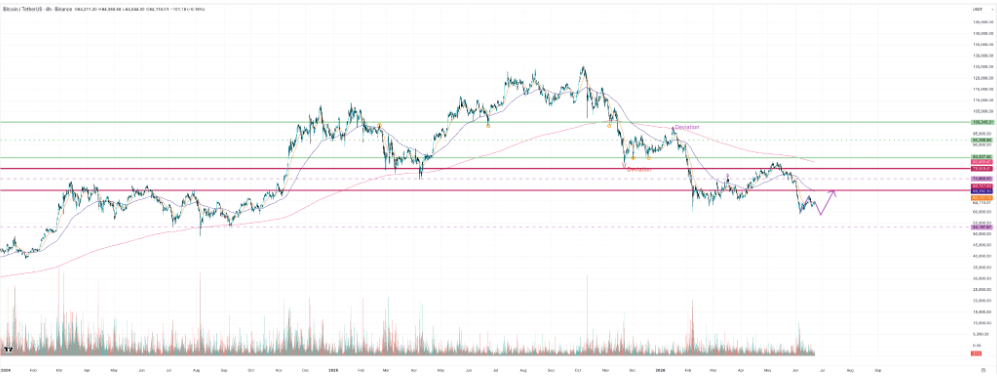
Support zone: low of the current range
Key short term level: $64.9K
Local recovery target: $68.5K
Major bull or bear level: $70.5K
Major upside liquidity zone: $79K to $80K
Bitcoin remains fragile, and the market is not yet showing enough evidence of a durable recovery.
The reset in short leverage actually reduces the probability of a short squeeze driven recovery. If the market were already sitting in a large short leverage position, the cleaner expectation would be a recovery rally fueled by short covering. That is not what we see today.
The market is currently sitting between two liquidity pockets. Low volume, weak ETF flows, and continued stablecoin off ramps point to further weakness toward the lows rather than a clean upside continuation.
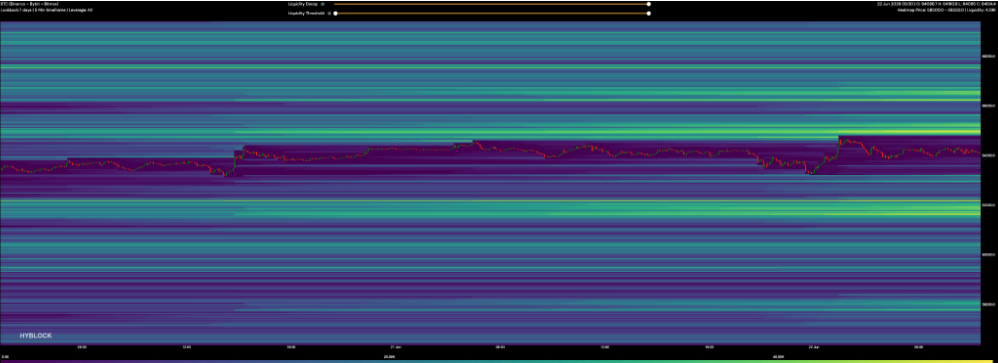
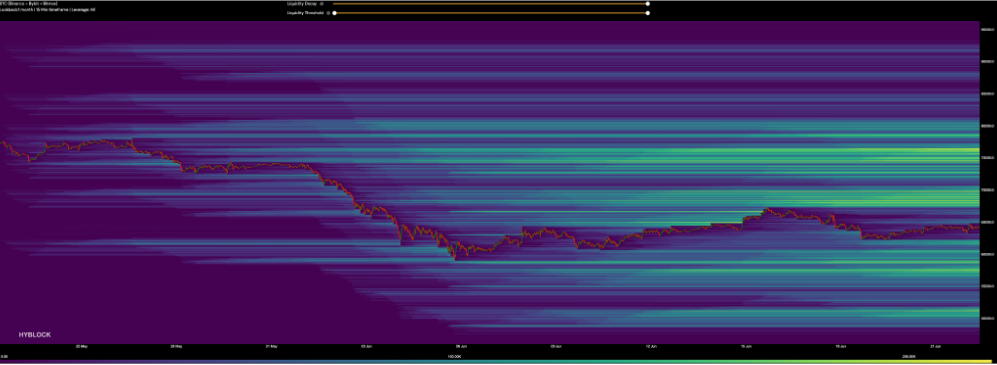
The preferred scenario is that Monday marks the high of the week, followed by a gradual move back toward the low of the range.
The invalidation level is $64.9K. A stabilization above that level would improve the short term setup and open the door to a recovery toward a new local top around $68.5K.
Ethereum
Support zone: low of the current range
Key short term level: $1,850
Major upside liquidity target: $2,150
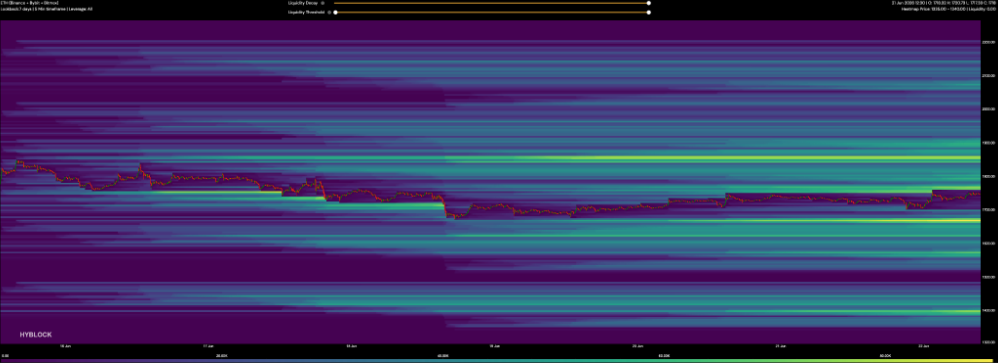
Ethereum remains weaker than Bitcoin.
ETH dominance improved slightly to 9.5%, but the broader setup remains difficult. Network usage is still weak, ETF outflows continue, and the Ethereum Foundation headlines add governance and funding uncertainty.
ETH needs to reclaim and hold $1,850 before the short term structure improves. Until then, the move should be viewed as a tactical recovery within a weaker broader trend.
The larger upside target remains $2,150, but Ethereum needs stronger relative strength, better ETF flows, and stronger network activity before that target becomes realistic.
Altcoins
Altcoin exposure should remain selective and limited.
The market is not yet showing the liquidity conditions needed for a broad altcoin rotation. Stablecoin liquidity remains weak, ETF flows are negative, and Ethereum has not shown enough leadership.
That said, there are still pockets of strength. Pre IPO perpetuals, tokenisation, stablecoin infrastructure, and regulated market structure remain the most interesting themes.
The better approach is to focus only on names with clear catalysts, strong product momentum, or specific market structure. Broad altcoin beta still looks premature.
Disclaimer: This content presents objective market data and does not constitute investment advice.

Copyright © 2026 Rain Management W.L.L.